
Appellate Courts
Subscribe to Appellate Courts's Posts

Tracking Tax Guidance and Court Cases

Oftentimes, taxpayers rely on various authorities in planning transactions and reporting them for tax purposes, as well as defending them during an Internal Revenue Service (IRS) audit, appeals or in litigation. These sources include authorities like the Internal Revenue Code, legislative history and other legislative materials, Treasury regulations and other IRS published guidance (e.g., revenue rulings, revenue procedures, notices, announcements), IRS private guidance (e.g., chief counsel advice, technical advice memoranda, private letter rulings, etc.), and case law. As we have discussed previously, these authorities are afforded different weight by courts and the IRS, and can serve different purposes in your matter.

(more…)


read more

Overview of Tax Litigation Forums

Taxpayers can choose whether to litigate tax disputes with the Internal Revenue Service (IRS) in the US Tax Court (Tax Court), federal district court or the Court of Federal Claims. Claims brought in federal district court and the Court of Federal Claims are tax refund litigation: the taxpayer must first pay the tax, file a claim for refund, and file a complaint against the United States if the claim is not allowed. Claims brought in the Tax Court are deficiency cases: the taxpayer can file a petition against the IRS Commissioner after receiving a notice of deficiency and does not need to pay the tax beforehand.

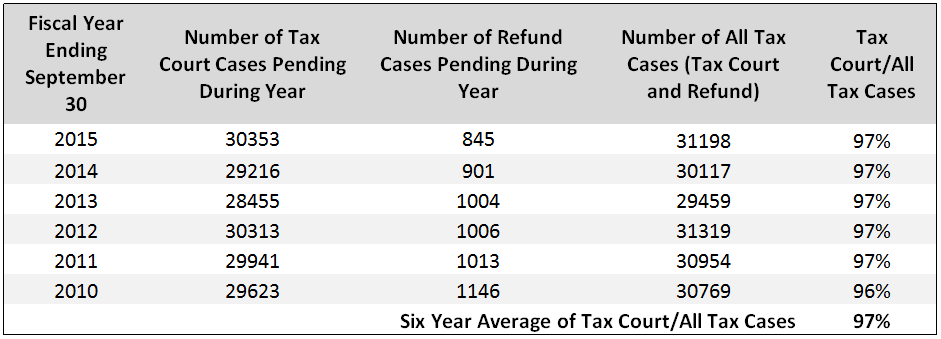
As demonstrated in the chart below, approximately 97 percent of tax claims are instituted in the Tax Court. It should be noted that, after a taxpayer files a petition in Tax Court, the taxpayer no longer has the option of bringing the claim in any other court for the year(s) at issue.

Tax Court Versus Tax Refund Litigation

Source: https://www.irs.gov/uac/soi-tax-stats-chief-counsel-workload-tax-litigation-cases-by-type-of-case-irs-data-book-table-27

(more…)


read more

APA Challenge to Notice of Deficiency: QinetiQ Requests Supreme Court Review

On April 4, 2017, QinetiQ U.S. Holdings, Inc. petitioned the US Supreme Court to review the US Court of Appeals for the Fourth Circuit’s decision that the Administrative Procedure Act of 1946 (APA) does not apply to the Internal Revenue Service (IRS) Notices of Deficiency. We previously wrote about the case (QinetiQ U.S. Holdings, Inc. v. Commissioner, No. 15-2192) here, here, here and here. To refresh, the taxpayer had argued in the US Tax Court that the Notice of Deficiency issued by the IRS, which contained a one-sentence reason for the deficiency determination, violated the APA because it was “arbitrary, capricious, an abuse of discretion, or otherwise not in accordance with law.” The APA provides a general rule that a reviewing court that is subject to the APA must hold unlawful and set aside an agency action unwarranted by the facts to the extent the facts are subject to trial de novo by the reviewing court. The Tax Court disagreed, emphasizing that it was well settled that the court is not subject to the APA and holding that the Notice of Deficiency adequately notified the taxpayer that a deficiency had been determined under relevant case law. The taxpayer appealed to the 4th Circuit, which ultimately affirmed the Tax Court’s decision. (more…)


read more

Santander Holdings USA Asks the Supreme Court to Address Economic Substance Doctrine

From 2003 to 2007, Sovereign Bancorp, Inc. (Sovereign) – now known as Santander Holdings USA, Inc. (Santander) – engaged in a so-called STARS transaction with Barclays Bank. According to Santander, “[b]y engaging in the STARS transaction, Sovereign transferred some of its income tax liability from the United States to the United Kingdom,” it “secured a loan of $1.15 billion,” and it received a payment “which effectively reduced its lending costs.” On its Federal corporate income tax returns for those years, Sovereign claimed foreign tax credits (FTCs) for UK taxes it paid in connection with the STARS transaction. It also claimed deductions for the interest paid on the $1.15 billion loan.

In 2009, the Internal Revenue Service (IRS) issued a Notice of Deficiency disallowing Sovereign’s FTCs and its deductions for interest paid on the $1.15 billion loan. The IRS did not challenge Sovereign’s compliance with the statutory and regulatory rules governing FTCs, instead arguing that Sovereign’s STARS transaction lacked “economic substance.” Sovereign paid the deficiency and sued for a refund in the US District Court for the District of Massachusetts. When the district court held for Sovereign on both issues, the IRS appealed to the US Court of Appeals for the First Circuit, but only with respect to the FTC issue. The crux of the issue was how to treat the UK taxes and the related FTCs for purposes of the “economic substance” analysis. Relying on Salem Financial, Inc. v. U.S., 786 F.3d 932 (Fed. Cir. 2015), and Bank of New York Mellon Corp. v. Comm’r, 801 F.3d 104 (2d Cir. 2015), the IRS argued that the UK taxes should be treated as an expense but that the related FTCs should be ignored in determining pre-tax profit. Citing IES Indus., Inc. v. U.S., 253 F.3d 350 (8th Cir. 2001), and Compaq Computer Corp. v. Comm’r, 277 F.3d 778 (5th Cir. 2001), Sovereign argued that either both should be included in the profit analysis or both should be ignored. The First Circuit held that Sovereign’s STARS transaction lacked “economic substance,” and upheld the disallowance of the FTCs at issue. In doing so, it treated the UK taxes as expenses that reduced pre-tax profit and ignored the related FTCs, following the Federal and Second Circuit’s approach. Santander Holdings USA, Inc. v. U.S., 844 F.3d 15 (1st Cir. 2016).

(more…)


read more

Tax Court Holds Section 883 Regulations Valid under Chevron Test

On March 28, 2017, the US Tax Court issued its opinion in Good Fortune Shipping SA v. Commissioner, 148 T.C. No. 10, upholding the validity of regulations issued under Internal Revenue Code (Code) Section 883.

Code Section 887(a) imposes a four percent tax on a foreign corporation’s US-source gross transportation income for each year. Code Section 883(c)(1) exempts from US tax a foreign corporation’s gross income from the international operation of ships if the foreign country in which the corporation is organized grants an equivalent exemption to corporations organized in the United States. Code Section 883(c)(1) provides that this exemption does not apply if 50 percent or more of the value of a foreign corporation’s stock is owned, directly or indirectly, by individuals who are not residents of a foreign country that grants an equivalent exemption to US corporations. Regulations issued under Section 883 provide that ownership through shares of a foreign corporation issued in bearer form is disregarded in determining whether the corporation passes the 50 percent or more test (Ownership Regulations).

The taxpayer in Good Fortune Shipping challenged the validity of the Ownership Regulations. It based its challenge on its claim that the Ownership Regulations do not satisfy the two prongs of the test under Chevron USA, Inc. v. Natural Resources Defense Council, Inc., 467 U.S. 837 (1984). This argument, in turn, was based primarily—if not exclusively—on the taxpayer’s assertion that US Congress had left no “gap” in Code Section 883 for US Department of the Treasury and the Internal Revenue Service (IRS) to fill; this is because the operative term “own” that appears in the statute has a common, ordinary meaning such that further interpretation by the IRS is not necessary. Thus, the taxpayer argued, the Ownership Regulations fail step one of the Chevron analysis. (more…)


read more

IRS Opposes Granting of Certiorari in Cases Addressing Definition of Return

Two petitions for certiorari pending before the Supreme Court of the United States ask the Court to resolve the question of whether a tax return filed after an assessment by the Internal Revenue Service (IRS) is a “return” for purposes of the Bankruptcy Code (BC). The answer to this question will determine whether a bankrupt taxpayer’s tax debts can be discharged or are permanently barred from discharge. According to these petitions, the courts of appeal are divided as to the answer.

BC § 523(a) generally allows a debtor to discharge unsecured debt, except for, inter alia, tax debts of debtors who: (1) failed to file tax returns; (2) filed fraudulent tax returns; or (3) filed late tax returns, where a bankruptcy petition is filed within two years of the date the late return was filed. See BC § 523(a)(1)(B)(i), (B)(ii), (C).

(more…)


read more

Fourth Circuit Clarifies the Role of the Collection Due Process Hearing

In Iames v. Commissioner, No. 16-1154, the US Court of Appeals for the Fourth Circuit upheld the US Tax Court’s ruling that once a taxpayer has unsuccessfully challenged his tax liability in a preassessment hearing before the Internal Revenue Service (IRS) Office of Appeals, he is precluded from challenging his tax liability in a collection due process (CDP) hearing under Internal Revenue Code (IRC) Section 6330.

IRC Section 6330, enacted by Congress to protect taxpayers from abusive or arbitrary collection practices, provides a set of procedural safeguards for taxpayers facing a potential levy action by the IRS: notice, an administrative hearing and judicial review. More specifically, before collecting a delinquent tax through a levy on a taxpayer’s property, the IRS must notify the taxpayer at least thirty days in advance of his right to an administrative hearing before the IRS Office of Appeals. IRC Section 6330(a) and (b). After the Office of Appeals makes its determination, the taxpayer may then petition the Tax Court for judicial review. IRC Section 6330(d)(1).

In general, the taxpayer may raise “any relevant issue relating to the unpaid tax or the proposed levy” at the CDP hearing. IRC Section 6330(c)(2)(A). There are, however, certain restrictions as to the circumstances under which a taxpayer may bring a CDP challenge. Under IRC Section 6330(c)(2)(B), a taxpayer can dispute the existence or amount of the underlying tax liability but only so long as he “did not otherwise have an opportunity to dispute such tax liability.”

(more…)


read more

Sixth Circuit Sets Limits on the Application of the Substance-Over-Form Doctrine

The judicial substance-over-form doctrine provides the IRS with the ability to set aside carefully orchestrated tax planning arrangements to treat a transaction consistent with its substance.  However, the doctrine does not give the Service carte blanche to deny tax benefits. In Summa Holdings, Inc. v. Commissioner, No. 16-1712 (available here), the Sixth Circuit overturned the Tax Court and declined to apply the substance-over-form doctrine when faced with taxpayers who, “to [their] good fortune, had the time and patience (and money) to understand how a complex set of tax provisions could lower [their] taxes” and “complied in full with the printed and accessible words of the tax laws.”

Summa Holdings involved a closely held corporation (Summa Holdings, Inc.) that supercharged the tax benefits provided by paying commissions to an interest charge domestic international sales corporation (IC-DISC) by having the IC-DISC owned by two Roth IRAs. While the dividends paid by the IC-DISC were taxable upon receipt, the dividend amounts (totaling $6 million over 7 years) were vastly larger than the annual contribution limits placed on Roth IRAs. For unfathomable reasons, the IRS did not challenge the $3,000 price that the Roth IRAs paid for the IC-DISC stock. Instead, the IRS asserted that that the substance of the arrangement was that the corporation paid dividends to its shareholders and the shareholders made excess contributions to the Roth IRAs.

(more…)


read more

Should Taxpayers File Amicus Briefs in Tax Court Cases?

Amicus–or “friend of the court”–briefs are not uncommon in Supreme Court and appellate court cases.  The purpose of an amicus brief is generally to provide assistance to the court by presenting additional arguments either in support or opposition of one of the litigant’s positions.  Amicus briefs should not rehash the same arguments presented by one of the parties, but rather should provide insights and a different perspective that is not presented by the parties, and to inform the court of the impact of the issues in the case on other affected parties.  The Federal Rules of Appellate Procedure provide detailed rules on how and when to file an amicus brief.  See here for Federal Rule of Appellate Procedure 29, which governs amicus filings.

Sometimes, amicus parties want to get involved at the trial court level before the trial record is fixed.  Thus, increasingly, amicus briefs are being filed in trial courts, and in particular in the United States Tax Court (Tax Court).  When, why and how to file an amicus brief in a trial court is not clear.  Indeed, most trial courts do not have procedural rules that directly address those filings.  This post provides an overview of some of the considerations and procedures for filing such briefs in a Tax Court case.

Whether to allow an amicus to participate in a case is within the sound discretion of the court.  Because the filing of an amicus brief is discretionary, the typical practice is to file a motion seeking permission or“leave” of the court to file an amicus brief accompanied with a statement stating that the litigants do, or do not, object to the filing of the amicus brief.

In deciding whether to grant permission to file anamicus brief, the Tax Court generally examines whether “the proffered information is timely, useful or otherwise helpful.”  The court also considers whether amici are advocates for one of the parties, have an interest in the outcome of the case and possess unique information or perspective.  This is consistent with the standards applied by other courts in making the determination.

Practice Point:  Several factors should be considered by taxpayers in deciding whether to file an amicus brief in Tax Court.  In addition to the cost, taxpayers may want to consider whether their position is being adequately represented by another taxpayer’s case and whether they believe that they can provide arguments that might persuade the court to adopt their position.  Participation as an amicus can also be helpful to taxpayers in coordinating legal positions and ensuring that the best possible arguments are presented on issues of first impression.  An effective amicus brief has the potential to persuade the court, and can be an effective tool to resolve an issue favorably.  This is especially true when, because of the specific facts of the taxpayer, the perspectives of other taxpayers are not adequately addressed.


read more

Change in Leadership at DOJ Tax Division

The Department of Justice (DOJ) Tax Division is responsible for litigating tax refund claims brought in Federal district courts and the Court of Federal Claims and handling appeals from decisions of the United States Tax Court (the Chief Counsel’s office is responsible for Tax Court litigation).  Effective January 23, 2017, David A. Hubbert became the Acting Assistant Attorney General for the DOJ Tax Division.  He replaces Carolyn Ciraolo, who resigned on January 20, 2017.  A copy of the DOJ press release, which includes biographical information on Mr. Hubbert, can be found here.  In accordance with the change, the Internal Revenue Service on January 31, 2017, announced corresponding changes in the address for correspondence to the DOJ Tax Division and the signature block for any Notice of Appeal from a Tax Court case.

Practice Note:  The changing of the guard is routine when there is a change in the administration, as demonstrated by the prior resignation of William J. Wilkins as Chief Counsel.  However, this year may be a little different as the new administration seems determined to “shake things up.”  In the coming weeks and months, we expect a lot of personnel changes.  Stay tuned!


read more

EDITOR IN CHIEF

STAY CONNECTED

TOPICS

ARCHIVES

jd supra readers choice top firm 2023 badge
US Tax Disputes Firm of the Year 2025
2026 Best Law Firms - Law Firm of the Year (Tax Law)