

IRS Audits
Subscribe to IRS Audits's Posts

Weekly IRS Roundup August 27 – 31, 2018

Presented below is our summary of significant IRS guidance and relevant tax matters for the week of August 27 – 31, 2018:

August 27, 2018: The IRS announced changes to its Compliance Assurance Process (CAP) program. We posted about the changes to CAP here.

August 28, 2018: In Notice 2018-70, the IRS announced that it will issue proposed regulations clarifying the definition of a “qualifying relative” for various purposes, including the new $500 credit for certain dependents.

August 30, 2018: The Office of Management and Budget (OMB) completed its review of a proposal to remove parts of the Internal Revenue Code Section 385 regulations, which address the treatment of debt among members of an expanded affiliated group.

August 31, 2018: The IRS released Revenue Procedure 2018-58, which includes the current list of jurisdictions subject to reporting requirements for certain deposit interest paid to nonresident alien individuals.

August 31, 2018: The IRS published statistics regarding US source income payments to foreign persons reported on Form 1042-S.

August 31, 2018: The IRS released its weekly list of written determinations (e.g., Private Letter Rulings, Technical Advice Memorandum and Chief Counsel Advice).

Special thanks to Kevin Hall in our DC office for this week’s roundup.


read more
IRS Announces That CAP Will Continue

On August 27, 2018, the Internal Revenue Service (IRS) announced that the Compliance Assurance Process (CAP) program will continue, with some modifications.  As we previously discussed, the IRS began an assessment of the CAP program in August 2016 to determine if any recalibration was needed.

CAP is an IRS program that seeks to identify and resolve tax issues through open, cooperative, and transparent interaction between the IRS and Large Business and International (LB&I) taxpayers prior to the filing of a return.  The goal of CAP is greater certainty of the treatment of tax positions sooner and with less administrative burden than conventional post-file audits.  The program began in 2005, and became permanent in 2011.  Several notable taxpayers publically disclose their involvement in the CAP program. (more…)


read more

OVDP Ending September 28: Now Is the Time to Disclose

Earlier this year, the Internal Revenue Service (IRS) announced the ending of the 2014 Offshore Voluntary Disclosure Program (OVDP), its formal amnesty program for taxpayers with previously undisclosed interests in foreign assets and financial accounts. The program deadline is September 28, 2018, and all submissions must be substantially completed by that deadline. Partial or “placeholder” submissions will not qualify. All requests for preclearance into the program must be submitted by Friday, August 24, 2018.

A number of other disclosure options will remain available after September 28, 2018, including the popular IRS streamlined compliance procedures. Regardless, taxpayers with potential questions or concerns regarding reporting of their foreign holdings should seek advice immediately in light of upcoming deadlines.


read more

IRS Releases Practice Unit on Examining Transaction Costs

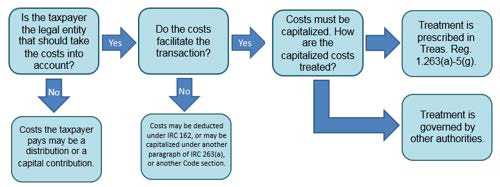
On July 18, 2018, the Internal Revenue Service (IRS) released a Practice Unit advising IRS agents on the framework to follow in analyzing the tax treatment of transaction costs incurred by taxpayers in executing business practices. The latest Practice Unit provides guidance to IRS examiners in determining whether transaction costs must be capitalized or can be immediately deducted, and focuses on the so-called INDOPCO regulations contained in Treasury Regulation § 1.263-5. (For more information and background, see here.)

According to the Practice Unit, there is a three-step process applied to analyze a transaction costs issue:

  1. Determine whether the taxpayer is the proper legal entity to take the transaction costs into account for tax purposes;
  2. Determine whether the costs facilitate the transaction; and
  3. Determine how the taxpayer should treat facilitative costs it must capitalize.

The key considerations and outcomes for each step are illustrated in the Practice Unit as follows:

Practice Point: Determining whether transaction costs must be capitalized or can be deducted is sometimes a difficult process. The IRS has attempted to create bright-line rules in this area, but invariably there are factual situations not covered by the INDOPCO regulations and disputes that may arise. Understanding the IRS’s approach to examining transaction costs, as set forth in this Practice Unit, may assist taxpayers under examination in resolving these types of issues.


read more

IRS Funding Woes Realized? Audit Rate at 15-Year Low!

A shrinking Internal Revenue Budget (IRS) budget has meant that fewer agents are available to make sure that the tax laws are being enforced. We have reported previously about how Congress has decreased the IRS’s budget.  In 2017, the audit rate fell to its lowest levels in 15 years because of a shrinking IRS budget and workforce. Indeed, your chance of being audited fell to 0.6% in 2017, the lowest rate since 2002. Similarly, tax collection levies fell 32% from the prior year, and the IRS filed 5% fewer liens year-over-year. Detailed information from the IRS can be found here.

Practice Point. The decreased funding of the IRS in the wake of bipartisan disagreements seems to have quelled in recent weeks. We have seen movement to get the IRS more funding in the wake of tax reform but it remains to be seen whether some of those funds will be used to increase the enforcement functions of the IRS. We anticipate, however, an increase in enforcement activity as a result of some of the positions taken by taxpayers in anticipation of tax reform and the myriad of interpretive questions that are expected to result from the new tax laws.


read more

New Proposed Regulations Limit Use of Non-Government Attorneys

On March 28, 2018, the Treasury Department and Internal Revenue Service (IRS) published Proposed Regulation § 301.7601-1(b)(3)(i) and (ii) which permits the IRS to hire outside specialists to assist in determining the correctness of a taxpayer’s tax liability. The Proposed Regulation also contains an exception specifically prohibiting the IRS from hiring outside attorneys to review summoned information or question witnesses providing testimony under oath.

The participation of outside attorneys became controversial during the audit of a large technology company when the IRS hired an outside law firm to augment its own resources for the transfer pricing audit of the company. On October 16, 2017, in response to the requirements of Executive Order 13789, requiring the Secretary of the Treasury to review all regulations issued after January 1, 2016, the Treasury Department and the IRS announced that they were considering proposing an amendment to Treas. Reg. § 301.7602-1(b)(3) in order to narrow the scope with respect to non-government attorneys. See our prior coverage here. (more…)


read more

IRS OVDP Ending | Time Is Now for Coming into US Tax Compliance – Especially for Those with Willfulness Issues

On March 13, 2018, the Internal Revenue Service (IRS) announced that it will begin ramping down the current Offshore Voluntary Disclosure Program (OVDP) and urged taxpayers with undisclosed foreign assets to apply for the program prior to its close on September 28, 2018. We have previously reported on developments in the OVDP.

Access the full article. 


read more

Statutes of Limitation and International Taxes

In late 2017, we provided a brief overview of statutes of limitation in the international tax context. At that time, we noted a forthcoming article on the subject.  We are pleased to report that our expanded article on the subject has been published in the January-February 2018 edition of the International Tax Journal.  The full article can be viewed here.


read more

The IRS May Be Coming for Your Bitcoins

If you have traded Bitcoin or other crypto-currencies, you probably know that their taxation may be as uncertain as your potential for reward or loss. Since 2014, the Internal Revenue Service (IRS) has publicized how it believes these investments should be treated for US federal income tax purposes. If you have failed to report your virtual currency transaction, the result in Coinbase, a recent IRS “John Doe” summons enforcement case, should convince you that it is time to ensure you are compliant with tax laws. The IRS may be coming for your Bitcoins!

IRS Guidance – Bitcoins Are Property

In IRS Notice 2014-21, 2014-16 IRB 938, the IRS explained that so-called “virtual currencies” that can be exchanged for traditional currency are “property” for federal income tax purposes. As such, a taxpayer must report gain or loss on its sale or exchange, measured against the taxpayer’s cost to purchase the virtual currency. In the notice, the IRS also made clear that “virtual currencies” are not currency for Internal Revenue Code (IRC) section 988 purposes. (more…)


read more

Expect Controversy in the Wake of Tax Reform

Tax reform is here to stay (at least for the foreseeable future). The Internal Revenue Service (IRS) may receive additional funds to implement the new tax law. With lowered tax rates, accelerated expensing and forced repatriation of foreign earnings comes an increased risk of an IRS audit. This brave new tax world has left so many questions that tax advisors’ phones have been ringing off the hooks! But as the end of the 2017 year and first quarter of 2018 dust settles, be mindful of the IRS audit to come. (more…)


read more

STAY CONNECTED

TOPICS

ARCHIVES

US Tax Disputes Firm of the Year 2025
2026 Best Law Firms - Law Firm of the Year (Tax Law)
jd supra readers choice top firm 2023 badge