
Trial Courts
Subscribe to Trial Courts's Posts

Canadian Tax Court Holds that Agreements Reached Under the Mutual Agreement Procedure are Binding on the Canada Revenue Agency

On March 10, 2017, the Tax Court of Canada held that agreements reached under the Mutual Agreement Procedure (MAP) precluded the Canada Revenue Agency (CRA) from redetermining the transfer prices of rock salt sold by Sifto Canada Corp. (Sifto Canada) to a related party in the United States.

In 2006, Sifto Canada reevaluated the transfer pricing of its rock salt sales to its US affiliate for 2002 through 2006. Siftco Canada discovered that the sales prices had been for less than an arm’s length price and in 2007 made an application to the CRA’s voluntary disclosure program reporting additional income from the sale of rock salt for 2002-2006 of over C$13 million. In 2008, the CRA accepted the application and assessed additional tax on that income.

After the assessment, Sifto Canada applied to the Canadian Competent Authority (CCA) and its US affiliate applied to the United States Competent Authority (USCA) for relief from double taxation under Articles IX and XXVI of the Convention between Canada and the United States of America with Respect to Taxes on Income and on Capital, as amended (the Treaty). The CRA did not audit Sifto Canada during this time and based its position paper on Sifto Canada’s voluntary disclosure application. Under the MAP process, the USCA and CCA then agreed to the transfer prices.

During the negotiation process for the MAP, the CRA began auditing the transfer prices of the rock salt for those years and then, subsequent to the signing of the MAP agreements, the CRA determined that the transfer prices should have been even higher than the amounts reported by Sifto Canada in the voluntary disclosure and issued further reassessments of its tax.

The CRA argued that: (1) the MAP agreements only provided relief from double taxation and did not set transfer prices; (2) the CCA only entered into agreements with the USCA and did not enter into a binding agreement with Sifto Canada regarding the transfer prices; and (3) that the government had a duty to reassess the tax once it determined that the transfer prices were not at arm’s length.

The Tax Court of Canada did not agree with the CRA and held the government to its MAP agreements. The Court found that by reaching an agreement under the MAP process, the CCA necessarily had to find that the transfer prices were at arm’s length under the Treaty. Further, the Court found that under the factual matrix of this case, the CCA’s letters exchanged with Siftco Canada clearly described the terms of the MAP agreements, asked Siftco Canada to accept those terms, and Sifto Canada then accepted the terms establishing a binding agreement. Finally, the Court found the agreements were not “indefensible on the facts and the law” and thus were binding on the Canadian government.

Practice Point:  This case is helpful to taxpayers with cross-border transactions between the US and Canada and demonstrates that MAP agreements are binding on the CRA.


read more

The IRS’s Assault on Section 199 (Computer Software) Doesn’t Compute

Internal Revenue Code Section 199 permits taxpayers to claim a 9 percent deduction related to the costs to develop software within the U.S. The relevant regulations and their interpretation, however, place substantial restrictions on claiming the benefit.

Moreover, the regulations and the government’s position haven’t kept up with the technological advances in computer software.

Before claiming the deduction on your return, consider that the Internal Revenue Service has this issue within its sights, and perhaps it will be the subject of one of their new “campaigns.”

In 2004, Congress enacted I.R.C. Section 199 to tip the scales of global competitiveness more in favor of American business. The main motivation of the statute was to create jobs by encouraging businesses to manufacture and produce their products in the U.S. The tax benefit, however, isn’t available for services, a theme that pervades many of the provisions in the statute and regulations.

Continue Reading

Originally published in Bloomberg BNA Daily Tax Report – April 24, 2017 – Number 77


read more

Overview of Tax Litigation Forums

Taxpayers can choose whether to litigate tax disputes with the Internal Revenue Service (IRS) in the US Tax Court (Tax Court), federal district court or the Court of Federal Claims. Claims brought in federal district court and the Court of Federal Claims are tax refund litigation: the taxpayer must first pay the tax, file a claim for refund, and file a complaint against the United States if the claim is not allowed. Claims brought in the Tax Court are deficiency cases: the taxpayer can file a petition against the IRS Commissioner after receiving a notice of deficiency and does not need to pay the tax beforehand.

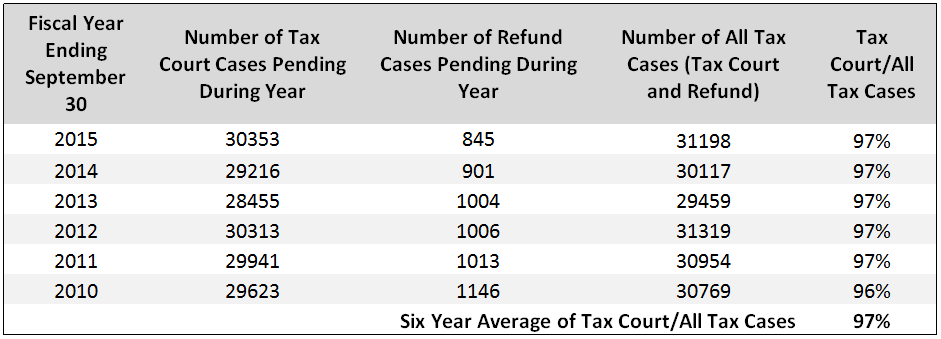
As demonstrated in the chart below, approximately 97 percent of tax claims are instituted in the Tax Court. It should be noted that, after a taxpayer files a petition in Tax Court, the taxpayer no longer has the option of bringing the claim in any other court for the year(s) at issue.

Tax Court Versus Tax Refund Litigation

Source: https://www.irs.gov/uac/soi-tax-stats-chief-counsel-workload-tax-litigation-cases-by-type-of-case-irs-data-book-table-27

(more…)


read more

APA Challenge to Notice of Deficiency: QinetiQ Requests Supreme Court Review

On April 4, 2017, QinetiQ U.S. Holdings, Inc. petitioned the US Supreme Court to review the US Court of Appeals for the Fourth Circuit’s decision that the Administrative Procedure Act of 1946 (APA) does not apply to the Internal Revenue Service (IRS) Notices of Deficiency. We previously wrote about the case (QinetiQ U.S. Holdings, Inc. v. Commissioner, No. 15-2192) here, here, here and here. To refresh, the taxpayer had argued in the US Tax Court that the Notice of Deficiency issued by the IRS, which contained a one-sentence reason for the deficiency determination, violated the APA because it was “arbitrary, capricious, an abuse of discretion, or otherwise not in accordance with law.” The APA provides a general rule that a reviewing court that is subject to the APA must hold unlawful and set aside an agency action unwarranted by the facts to the extent the facts are subject to trial de novo by the reviewing court. The Tax Court disagreed, emphasizing that it was well settled that the court is not subject to the APA and holding that the Notice of Deficiency adequately notified the taxpayer that a deficiency had been determined under relevant case law. The taxpayer appealed to the 4th Circuit, which ultimately affirmed the Tax Court’s decision. (more…)


read more

Santander Holdings USA Asks the Supreme Court to Address Economic Substance Doctrine

From 2003 to 2007, Sovereign Bancorp, Inc. (Sovereign) – now known as Santander Holdings USA, Inc. (Santander) – engaged in a so-called STARS transaction with Barclays Bank. According to Santander, “[b]y engaging in the STARS transaction, Sovereign transferred some of its income tax liability from the United States to the United Kingdom,” it “secured a loan of $1.15 billion,” and it received a payment “which effectively reduced its lending costs.” On its Federal corporate income tax returns for those years, Sovereign claimed foreign tax credits (FTCs) for UK taxes it paid in connection with the STARS transaction. It also claimed deductions for the interest paid on the $1.15 billion loan.

In 2009, the Internal Revenue Service (IRS) issued a Notice of Deficiency disallowing Sovereign’s FTCs and its deductions for interest paid on the $1.15 billion loan. The IRS did not challenge Sovereign’s compliance with the statutory and regulatory rules governing FTCs, instead arguing that Sovereign’s STARS transaction lacked “economic substance.” Sovereign paid the deficiency and sued for a refund in the US District Court for the District of Massachusetts. When the district court held for Sovereign on both issues, the IRS appealed to the US Court of Appeals for the First Circuit, but only with respect to the FTC issue. The crux of the issue was how to treat the UK taxes and the related FTCs for purposes of the “economic substance” analysis. Relying on Salem Financial, Inc. v. U.S., 786 F.3d 932 (Fed. Cir. 2015), and Bank of New York Mellon Corp. v. Comm’r, 801 F.3d 104 (2d Cir. 2015), the IRS argued that the UK taxes should be treated as an expense but that the related FTCs should be ignored in determining pre-tax profit. Citing IES Indus., Inc. v. U.S., 253 F.3d 350 (8th Cir. 2001), and Compaq Computer Corp. v. Comm’r, 277 F.3d 778 (5th Cir. 2001), Sovereign argued that either both should be included in the profit analysis or both should be ignored. The First Circuit held that Sovereign’s STARS transaction lacked “economic substance,” and upheld the disallowance of the FTCs at issue. In doing so, it treated the UK taxes as expenses that reduced pre-tax profit and ignored the related FTCs, following the Federal and Second Circuit’s approach. Santander Holdings USA, Inc. v. U.S., 844 F.3d 15 (1st Cir. 2016).

(more…)


read more

Tax Court Holds Section 883 Regulations Valid under Chevron Test

On March 28, 2017, the US Tax Court issued its opinion in Good Fortune Shipping SA v. Commissioner, 148 T.C. No. 10, upholding the validity of regulations issued under Internal Revenue Code (Code) Section 883.

Code Section 887(a) imposes a four percent tax on a foreign corporation’s US-source gross transportation income for each year. Code Section 883(c)(1) exempts from US tax a foreign corporation’s gross income from the international operation of ships if the foreign country in which the corporation is organized grants an equivalent exemption to corporations organized in the United States. Code Section 883(c)(1) provides that this exemption does not apply if 50 percent or more of the value of a foreign corporation’s stock is owned, directly or indirectly, by individuals who are not residents of a foreign country that grants an equivalent exemption to US corporations. Regulations issued under Section 883 provide that ownership through shares of a foreign corporation issued in bearer form is disregarded in determining whether the corporation passes the 50 percent or more test (Ownership Regulations).

The taxpayer in Good Fortune Shipping challenged the validity of the Ownership Regulations. It based its challenge on its claim that the Ownership Regulations do not satisfy the two prongs of the test under Chevron USA, Inc. v. Natural Resources Defense Council, Inc., 467 U.S. 837 (1984). This argument, in turn, was based primarily—if not exclusively—on the taxpayer’s assertion that US Congress had left no “gap” in Code Section 883 for US Department of the Treasury and the Internal Revenue Service (IRS) to fill; this is because the operative term “own” that appears in the statute has a common, ordinary meaning such that further interpretation by the IRS is not necessary. Thus, the taxpayer argued, the Ownership Regulations fail step one of the Chevron analysis. (more…)


read more

Giving Back – Providing Pro Bono Tax Assistance

Here at McDermott, we value giving back to the community through pro bono efforts.  In particular, we provide substantial assistance in pro bono tax cases to low-income individuals through our relationships with low-income taxpayer clinics throughout the country.  Over the years, we have settled dozens of cases for low-income taxpayers in docketed tax cases and routinely reduced or eliminated deficiencies asserted by the Internal Revenue Service (IRS).  When settlement has not been possible, we have litigated cases in the Tax Court and obtained favorable results not just for our clients but for the low-income taxpayer community as a whole.  For example, we represented a husband and wife on a penalty issue involving an issue of first impression and convinced the Tax Court that the IRS had for years been improperly asserting and collecting penalties on improperly claimed refundable tax credits. In a recent article, we detail some of the pro bono efforts by low-income taxpayer clinics and private practitioners.

Practice Point:  In addition to assisting low-income individuals who cannot afford legal representation, providing pro bono tax services benefits tax practitioners in many ways.  It provides the opportunity for younger attorneys to take responsibility for a case and to get valuable experience in dealing with clients, negotiating with the IRS, and potentially gaining courtroom experience.  Assisting taxpayers on a pro bono basis is also rewarding and can make a significant difference in the lives of low-income individuals.


read more

Retaliation Claims By Corporate Whistleblowers – What Is Too Far?

This week, a French court announced an indictment against UBS related to its alleged treatment of Nicholas Forissier, a former audit manager who provided information to French authorities a decade ago in a tax evasion investigation of UBS.  According to at least one press account, the indictment alleges that Forissier was “forced to work under difficult conditions, including internal criticism and eventual dismissal for gross misconduct in 2009” in retaliation for his cooperation with French authorities. Forissier’s case is apparently one of several whistleblower retaliation claims percolating in the French courts against UBS regarding non-disclosure of offshore accounts for tax purposes.

US law provides significant protections of potential whistleblowers for alleged tax violations. Revisions to IRC section 7623, effective from December 20, 2006, make whistleblower awards mandatory in some cases. The revised law has resulted in several large, public awards (the $104 million award given to Bradley Birkenfeld, for example, also related to UBS disclosures).

Protection for IRS whistleblower claimants is found under a number of statutes and rules.  IRC section 6103(i)(6) provides stringent confidentiality rules (including personal liability for government violators) regarding the government’s disclosure of information tending to reveal the existence of a whistleblower or confidential informant.  Also, the grand jury secrecy rule, Fed. R. Crim. P. 6(e), may provide an additional protection in an ongoing grand jury investigation. Further, OSHA, the False Claims Act and the Fair Labor Standards Act may provide protections against termination of whistleblowers and against adverse employment decisions related to a current employee’s status as a whistleblower, in an appropriate case.

Practice point:  It is also worth noting that these protections are not absolute. In fact, because an IRS whistleblower claimant may be in a privileged relationship with the target of an investigation, the IRS has more recently been called upon to clarify that the agency cannot and should not gather or use privileged information to develop a case, or else undermine the entire case as a violation of that privilege, i.e., the “fruit of the poisonous tree”. See our prior coverage on this issue here.


read more

Should Taxpayers File Amicus Briefs in Tax Court Cases?

Amicus–or “friend of the court”–briefs are not uncommon in Supreme Court and appellate court cases.  The purpose of an amicus brief is generally to provide assistance to the court by presenting additional arguments either in support or opposition of one of the litigant’s positions.  Amicus briefs should not rehash the same arguments presented by one of the parties, but rather should provide insights and a different perspective that is not presented by the parties, and to inform the court of the impact of the issues in the case on other affected parties.  The Federal Rules of Appellate Procedure provide detailed rules on how and when to file an amicus brief.  See here for Federal Rule of Appellate Procedure 29, which governs amicus filings.

Sometimes, amicus parties want to get involved at the trial court level before the trial record is fixed.  Thus, increasingly, amicus briefs are being filed in trial courts, and in particular in the United States Tax Court (Tax Court).  When, why and how to file an amicus brief in a trial court is not clear.  Indeed, most trial courts do not have procedural rules that directly address those filings.  This post provides an overview of some of the considerations and procedures for filing such briefs in a Tax Court case.

Whether to allow an amicus to participate in a case is within the sound discretion of the court.  Because the filing of an amicus brief is discretionary, the typical practice is to file a motion seeking permission or“leave” of the court to file an amicus brief accompanied with a statement stating that the litigants do, or do not, object to the filing of the amicus brief.

In deciding whether to grant permission to file anamicus brief, the Tax Court generally examines whether “the proffered information is timely, useful or otherwise helpful.”  The court also considers whether amici are advocates for one of the parties, have an interest in the outcome of the case and possess unique information or perspective.  This is consistent with the standards applied by other courts in making the determination.

Practice Point:  Several factors should be considered by taxpayers in deciding whether to file an amicus brief in Tax Court.  In addition to the cost, taxpayers may want to consider whether their position is being adequately represented by another taxpayer’s case and whether they believe that they can provide arguments that might persuade the court to adopt their position.  Participation as an amicus can also be helpful to taxpayers in coordinating legal positions and ensuring that the best possible arguments are presented on issues of first impression.  An effective amicus brief has the potential to persuade the court, and can be an effective tool to resolve an issue favorably.  This is especially true when, because of the specific facts of the taxpayer, the perspectives of other taxpayers are not adequately addressed.


read more

Tax Court Affirms That Reportable Transaction Penalty Is Constitutional

In Thompson v. Commissioner, 148 T.C. No. 3 148 (2017), the US Tax Court confirmed that the Internal Revenue Code (IRC) Section 6662A penalty for reportable transactions is constitutional and does not violate the Excessive Fines Clause of the Eighth Amendment.

IRC Section 6662A(a) imposes a penalty on any “reportable transaction understatement.” A “reportable transaction understatement” generally refers to the difference between the increase in the amount of federal income tax that is calculated from the proper treatment of an item that results from a reportable or listed transaction and the taxpayers actually treatment of that item.  IRC Section 6662A(b). If a taxpayer fails to adequately disclose a reportable transaction giving rise to an understatement under IRC section 6662A, the penalty is imposed at a rate of 30 percent, and there are no available defenses. IRC Section 6662A(c). However, if a taxpayer sufficiently discloses the details of the transaction, the penalty rate is 20 percent of the amount of the reportable transaction understatement. IRC Section 6662A(a). In this latter instance, a taxpayer may avoid the penalty if he shows reasonable cause and good faith, as well as that there is substantial authority for a position he claimed on the tax return, and the taxpayer reasonably believed that such treatment was more likely than not the proper treatment of the transaction in question. IRC Section 6664(d)(1) and (3).

(more…)


read more

EDITOR IN CHIEF

STAY CONNECTED

TOPICS

ARCHIVES

US Tax Disputes Firm of the Year 2025
2026 Best Law Firms - Law Firm of the Year (Tax Law)
jd supra readers choice top firm 2023 badge