
IRS
Subscribe to IRS's Posts

TIGTA Report: FOIA Procedures Need Improvement

On September 7, 2017, the Treasury Inspector General for Tax Administration (TIGTA) issued a report about the Internal Revenue Service’s (IRS) Freedom of Information Act (FOIA) procedures. After reviewing a statistically valid sample of FOIA requests, TIGTA concluded that the IRS improperly withheld information 14.3 percent of the time—or approximately 1 in 7 FOIA requests.

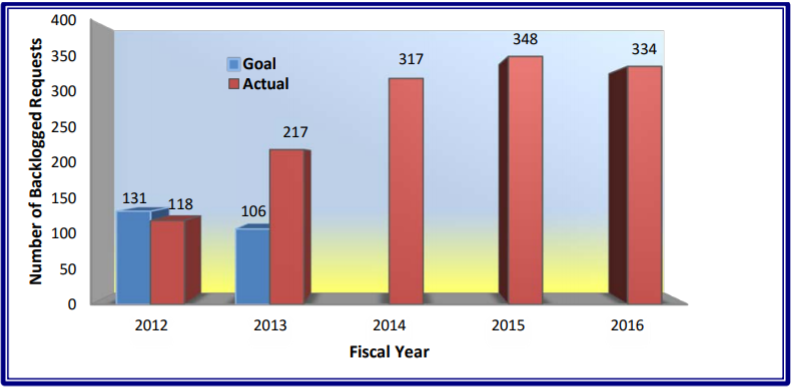
TIGTA also found that at the end of Fiscal Year 2016, there were 334 backlogged information requests. Below is a chart from the report showing the IRS’s recent history of backlogged FOIA requests.

TIGTA’s findings are consistent with our experiences with FOIA requests. It is not unusual for the IRS to make repeated requests for extensions to respond. We note further that, during an examination, the IRS is statutorily authorized to provide taxpayers access to their administrative file. Indeed, the Internal Revenue Manual confirms this at section 4.2.5.7 (June 15, 2017). Yet the IRS examination team often requires a FOIA request.

Practice Point 1: As a result of the IRS’s FOIA backlog, some taxpayers have resorted to filing lawsuits in federal district court to enforce their FOIA rights. Because the IRS must respond to court deadlines, taxpayers are sometimes able to force a more expedient response and move to the front of the response line.

Practice Point 2: Taxpayers should attempt to tailor their FOIA requests, only requesting the information in which they are interested. In theory, this could make the IRS’s job easier and, in turn, responses more timely.

Practice Point 3: If taxpayers intend to seek information from the government through the FOIA process, they should do so as soon as possible (e.g., at the beginning of the examination process) so that they may get the information in time to be useful.


read more

IRS Valuation Expert for Michael Jackson Estate Case Almost Thrown Out!

On September 29, 2017, Judge Mark Holmes of the United States Tax Court (Tax Court) issued an order in the estate tax valuation case brought by the Estate of Michael Jackson (the Estate). In the case, the Estate moved to strike the testimony of the Internal Revenue Service’s (IRS) valuation expert witness on the grounds that he lied. The IRS acknowledged that its expert “did not tell the truth when he testified that he did not work on or write a valuation report for the IRS Examination Division in the third-party taxpayer audit.” Apparently, the expert had worked on the valuation of Whitney Houston’s Estate on behalf of the IRS, and failed to list the engagement in his report. He also omitted one publication that he wrote and one case in which he provided expert-witness testimony at a deposition.

The question for the Court was the proper remedy for the omissions, with sanctions ranging from striking all of the expert’s testimony (and thereby depriving the IRS of the only evidence in its favor on the key issues in the case) to discounting the expert’s testimony and weight to be given to his opinions. The Court decided to take the latter route.

The Court explained that striking expert testimony pursuant to Tax Court Practice and Procedure Rule 143(g) (governing expert witness reports) occurs when a putative expert omits information from the report without good cause for the omission. In this case, the Court explained that the IRS’s expert failed to disclose his valuation work on his long list of expert-testimony engagements attached to his resume, but ruled that the omission was merely a “clerical error.” However, the expert did provide false testimony at trial when he testified he did not work on or write a valuation report in the matter involving Whitney Houston’s Estate. The Court determined that there had to be some negative consequences for the expert’s false testimony, and settled on discounting his credibility and opinions.

Practice Point: The order in Estate of Michael Jackson, as well as the Tax Court’s prior opinion in Tucker v. Commissioner, TC Memo. 2017-183, highlight a very important aspect of preparing an expert report for submission in Tax Court: it must be complete and accurate at the time of its submission. It is good practice to run a litigation database search (e.g., Lexis or Westlaw) on your expert’s testimony experience as a check on what the expert has listed in his report.


read more

Is a Business Tax Reform Game Plan Beginning to Take Shape?

Substantial tax reform is underway and the business community is intently awaiting details of this activity with the aim of positioning themselves to maximize opportunities and minimize any costs or risks that reform may present. How will a cut in the corporate income tax rate, the potential adoption of a “territorial” dividend exemption system or the elimination or altering of recent regulations impact companies?

Continue Reading


read more

IRS Guidance Says IRS Can Disclose Confidential Taxpayer Information to Whistleblower with Impunity

Every taxpayer should be aware of the real risk that its own employees could disclose the taxpayer’s confidential and privileged information to the Internal Revenue Service (IRS) for a whistleblower fee. Pursuant to Internal Revenue Code (Code) Section 7623, the IRS is permitted to pay a “whistleblower” who discloses information about a taxpayer who has violated the tax laws. The amount of the payment ranges from 15 to 30 percent of the recovery. We have previously reported about issues pertaining to whistleblowers.

While the flow of information is usually from the whistleblower to the IRS, there is also a risk that the IRS can disclose the taxpayer’s return information to the whistleblower. Code Section 6103(a) deems tax returns and return information as confidential and prohibits the disclosure absent an express statutory exception. Return information is broadly defined and includes the information received by the IRS, from any source, during the course of audit. There are several exceptions to this general rule. For example, Code Section 6103(n) authorizes that tax returns and return information may be shared with the IRS pursuant to a “tax administration contract.” The relevant regulations explain when the IRS may disclose information to a whistleblower and its representative.

A recent memo from the IRS’s Whistleblower Office provides the reasoning behind the IRS decision to enter into a whistleblower contract in order to share the taxpayer’s feeling empowered to share otherwise confidential protected information with whistleblowers. (more…)


read more

Tax Court Announces 2018 Judicial Conference in Chicago on March 26-28, 2018

On Friday, September 15, the Tax Court announced that it will be holding its 2018 Judicial Conference in Chicago, Illinois, on the campus of Northwestern University’s Pritzker School of Law on March 26-28, 2018. The press release provides:

The 2018 Tax Court Judicial Conference will be held in Chicago, Illinois, on the campus of Northwestern University’s Pritzker School of Law on Monday evening, March 26, 2018, Tuesday, March 27, 2018 (entire day), and Wednesday, March 28, 2018 (half day). The purpose of the judicial conference is to provide attendees with the opportunity to (1) review and discuss issues of material interest regarding the tax litigation process, (2) discuss ways in which the tax litigation process in the Court may be improved, and (3) network with fellow Tax Court practitioners. In addition to the Judges of the United States Tax Court, the Court intends to invite representatives from the Internal Revenue Service, the Department of Justice, private practice, low-income taxpayer clinics, academia, Capitol Hill, and other courts. A variety of plenary and breakout sessions will address issues relevant to practice before the Court.

Applications to attend the 2018 Tax Court Judicial Conference will be accepted from September 15, 2017, through November 15, 2017. An application form is available on the Court’s website at https://www.ustaxcourt.gov/judicial_conference_application.pdf. Please note that space is limited, and the Court may not be able to extend an invitation to all those who apply.

We have attended the Tax Court Judicial Conference on several occasions and have spoken on panels at the conference. The material presented is extremely informative and provides a unique opportunity to personally interact with judges and fellow Tax Court practitioners. Applications are being accepted from now through November 15, 2017, either by email or regular mail. If you plan to attend, please send us an email so we can say hello!


read more

More Changes to IRS Appeals, in Response to Taxpayer and Practitioner Concerns

As we have recently discussed, Internal Revenue Service (IRS) Appeals has been making a number of changes to their administrative review process in the last few years. While many of these changes have been driven by lack of resources, others—like the standing invitation of Exam into the Appeals process—have the potential to undermine the independence of Appeals, which has historically been a vital component of the taxpayer’s right of redress with the Service.

In this week’s American Bar Association conference in Austin, Texas, IRS Appeals clarified that, for field cases worked by revenue agents, taxpayers may still receive in-person conferences, despite recent pronouncements that phone conferences are the preferred or default method. Conferences in campus cases (or correspondence audit cases) will still be generally handled by telephone, but there will eventually be a move to in-person conferences by request. Campus cases are being treated differently because they are often managed in locations remote from the taxpayer without adequate facilities for in-person meetings. Guidance will be issued to IRS employees regarding these changes.

As Taxpayer Advocate Nina E. Olson noted, these changes are helpful but not enough. In particular, Olson expressed dismay that campus cases were not being included in the change. Roughly 75 to 80 percent of IRS examinations are conducted by correspondence. In these cases, there is a great need for personal contact with the taxpayer, but no single person within the Service is assigned to a case.

Practice Point: The new announcement provides practitioners with additional support for their requests for in-person Appeals conferences. In our experience, an in-person conference is frequently much more productive than one by phone, and practitioners should request these whenever possible.


read more

Form 2848 Power of Attorney – Important Practice Tip

Forms 2848 Power of Attorney and Declaration of Representative are intended to authorize the Internal Revenue Service (IRS) to discuss a taxpayer’s confidential tax matters with a designated representative. Generally, the form requires the taxpayer to identify the tax form number (where applicable), a description of the matter and specify the applicable tax year(s) for the authorization to be valid. If the IRS determines that an issue is beyond the scope outlined in the Form 2848 they will not discuss that item with the representative. It is important to understand how the IRS interprets these restrictions.

Importantly, on September 8, 2017, the IRS released TAM 201736021, dated August 1, 2017, which expresses a narrow view of whether certain civil penalties are related to certain tax returns for purposes of a Form 2848 authorization. The TAM notes that “merely listing ‘civil penalties’ on Line 3 of the Form 2848” may no longer be sufficient authorization if the civil penalty relates to a return that is not otherwise enumerated within the Form 2848. For example, the TAM concluded that a Form 2848 only identifying an income tax return, such as a Form 1120 or Form 1040, would not constitute authorization for the IRS to discuss civil penalties related to international information returns that may have to be filed with the income tax return, such as a Form 5471. Under the IRS’s view, the civil penalty would be related to the Form 5471 but not the Form 1120.

The TAM provided a second example, reaching a similar conclusion regarding the relationship between a Form 1040 and a Form 3520. In short, authorization would not exist for the IRS to discuss with a representative whether an IRC section 6677 civil penalty for failure to file Form 3520 is applicable if the Form 2848 only identifies the Form 1040. This result may be more intuitive since the Form 3520 is not attached to the Form 1040 and is required to be filed separately. However, it is still more demanding than having a broader application of the “civil penalties” designation on the Form 2848.

Practice Point 1: Forms 2848 are generally executed at the outset of a matter when it may not be readily apparent in what direction the audit will progress or what issues the IRS may focus on. While we disagree with the IRS’s position as stated in the TAM, taxpayers and practitioners need to be cognizant of the IRS’s position and may need to revisit their Forms 2848 during the course of an audit.

Practice Point 2: As a general matter, the IRS agent handling an audit will tell the practitioner if the agent believes that a current Form 2848 is not sufficient, but that does not always happen. So it is good practice for taxpayers to send the practitioner any correspondence or notices that they receive from the IRS and not merely rely on the presumption that the IRS also mailed a copy to the practitioner listed on the Form 2848.


read more

Tax Court Rejects IRS Argument that Corporate Taxpayer Failed to File Valid Return

The issue of whether a valid tax return has been filed usually comes up in the context of individuals. One common situation involves taxpayers who file so-called zero returns or returns with an altered jurat and protest paying any taxes. Another common situation, which has received substantial attention lately, involves whether a tax return filed after an assessment by the Internal Revenue Service (IRS) is a “return” for purposes of the Bankruptcy Code. We previously posted on the latter.

This post focuses on the uncommon situation where the IRS disputes whether a corporate taxpayer filed a valid return. As we have previously discussed, in the widely cited Beard v. Commissioner, 82 TC 766 (1984), the Tax Court defined a four-part test (the Beard Test) for determining whether a document constitutes a “return.” To be a return, a document must: (1) provide sufficient data to calculate tax liability; (2) purport to be a return; (3) be an honest and reasonable attempt to satisfy the requirements of the tax law; and (4) be executed by the taxpayer under penalties of perjury. This test applies to all types of taxpayers, and its application to corporate taxpayers was recently highlighted in New Capital Fire, Inc. v. Commissioner, TC Memo. 2017-177.

In New Capital Fire, Capital Fire Insurance Co. (Old Capital) merged into New Capital Fire, Inc. (New Capital), with New Capital surviving, on December 4, 2002. The merger was designed to be a tax-free reorganization under Internal Revenue Code (Code) Section 368(a)(1)(F). Old Capital did not file a tax return for any part of 2002 and New Capital filed a tax return for 2002 which included a pro forma Form 1120-PC, US Property and Casualty Insurance Company Income Tax Return, for Old Capital’s 2002 tax year. The IRS issued Old Capital a notice of deficiency in 2012 determining that Old Capital was required to file a return for the short tax year ending December 4, 2002, because the merger failed to meet to reorganization rules. (more…)


read more

IRS Extends Permanent Invitation to Exam to Attend Appeals Conferences

On May 1, 2017, the IRS issued FAQs concerning its recent practice of inviting IRS Examination Agents (Exam) into the Appeals discussion. The FAQs make clear that Exam will now be routinely invited to Appeals conferences. The release premises this procedural shift on perceived efficiencies of having Exam stay during the taxpayer’s rebuttal presentation. The FAQs explain, however, that settlement discussions with the taxpayer will be held without Exam present. This is an important clarification, and the FAQs explain that this new process is different from Rapid Appeals.

Practice Point: It is clear that diminishing resources have put substantial pressure on the Appeals process. In several recent Appeals sessions, Exam has been invited to stay for our clients’ rebuttal to Exam’s presentation. After the taxpayers’ presentation, Appeal tries to elicit a back-and-forth communication between the taxpayer and Exam, putatively to ensure that all of the relevant facts are developed and agreed upon. Exam typically has counsel at these Opening Conferences, which tends to make Exam more of an advocate as opposed to the traditional developer of the facts and of the IRS’s audit position. This two-way communication seems to be an attempt to morph the Appeals session into some type of mini-mediation akin to a FastTrack session. Taxpayers therefore must take care to plan their settlement strategy, as the line between development of the facts and discussion of the hazards can be blurry. While in some cases it might be useful to negotiate in the presence of the Exam team, we have found that more progress typically is made when Exam leaves the room.


read more

STAY CONNECTED

TOPICS

ARCHIVES

US Tax Disputes Firm of the Year 2025
2026 Best Law Firms - Law Firm of the Year (Tax Law)
jd supra readers choice top firm 2023 badge