
IRS
Subscribe to IRS's Posts

APA Challenge to Notice of Deficiency: QinetiQ Affirmed

On January 6, 2017, the US Court of Appeals for the Fourth Circuit, by published opinion, affirmed the US Tax Court’s (Tax Court) earlier ruling in QinetiQ US Holdings, Inc. v. Commissioner.  We previously wrote about the case here, here, and here.  To refresh, the taxpayer had argued in Tax Court that the Notice of Deficiency issued by the Internal Revenue Service (IRS), which contained a one-sentence reason for the deficiency determination, violated the Administrative Procedure Act (APA) because it was “arbitrary, capricious, an abuse of discretion, or otherwise not in accordance with law.”  The APA provides a general rule that a reviewing court that is subject to the APA must hold unlawful and set aside an agency action unwarranted by the facts to the extent the facts are subject to trial de novo by the reviewing court. The Tax Court disagreed, emphasizing that it was well settled that the court is not subject to the APA and holding that the Notice of Deficiency adequately notified the taxpayer that a deficiency had been determined under relevant case law.  The taxpayer appealed to the Fourth Circuit.

In an opinion written by Circuit Judge Barbara Keenan, the court concluded that the IRS complied with all applicable procedural requirements.  The court reasoned that the Internal Revenue Code (Code) provided a unique system for judicial review that should govern the content requirements for a Notice of Deficiency.  Per the court, it “is that specific body of law, rather than the more general provisions for judicial review authorized by the APA, that governs the content requirements of a Notice of Deficiency.”  The court cited a Fourth Circuit opinion from 1959, in which it held that the Code’s provisions for de novo review are incompatible with limited judicial review of final agency actions allowed under the APA.

The court held that the APA’s requirement of a reasoned explanation in support of a “final” agency action does not apply to a Notice of Deficiency issued by the IRS.  A Notice of Deficiency, the Court reasoned, cannot be a “final” agency action within the meaning of the APA, because the agency action is not one “by which rights or obligations have been determined, or from which legal consequences will flow.”  After issuing a Notice of Deficiency, the IRS may later assert in Tax Court new theories and allege additional deficiencies.  Moreover, a taxpayer may also raise new matters in Tax Court.  In addition, the court cited to the Supreme Court’s 1988 opinion in Bowen v. Massachusetts, emphasizing that Congress did not intend for the APA “to duplicate the previously established special statutory procedures relating to specific agencies.”

The court also held that the Notice of Deficiency issued to QinetiQ satisfied the requirement of Code section 7522(a), which requires that the IRS “describe [in the Notice] the basis for, and identify the amounts (if any) of, the tax due, interest, additional amounts, additions [...]

Continue Reading


read more

IRS Audits and IRS Appeals — A Year in Review

This year has been marked with substantial changes in the manner in which the Internal Revenue Service (IRS) operates. Shrinking resources and retiring IRS professionals have marred the IRS and its efficiency. The pervasive theme for 2016 was trying to do the job with fewer resources.  For example, IRS audits continue to devolve with standardized information document requests (IDRs), international practice unit guides and issue-focused examinations (mostly focused on international tax issues). We say “goodbye” to old friends [au revoir Compliance Assurance Process (CAP) Program] and hello to new rules (e.g., partnership entity audit rules and adjustments). And we have born witness to the slow evisceration of the independence of IRS Office of Appeals.

As we turn the corner to a new year, we expect the IRS’s war on taxpayers to manifest itself in “campaign” after “campaign,” reminiscent of the tiered issue system of days gone by. We expect coordination on a national level to reside with IRS “issue specialists” controlling and dictating audits and appeals, which will increasingly challenge the efficiency of pre-litigation resolution techniques. The end result of these contractions may very likely be an increase in tax litigation as frustration with the administrative process boils over. But the wild card, of course, is what changes will be ushered in by the new administration. Will it be business as usual, or will we see a complete overhaul of the system? Only time will tell, as we wait with bated breath for the ball to drop.  (more…)


read more

IRS Issues New IPU on FICA Rules for Employees Working Abroad

The Internal Revenue Service has made available unofficial but detailed and instructive guidance on the application of Social Security and Medicare taxes (FICA) to wages paid to employees working abroad. The new November 14, 2016, International Practice Unit (IPU) makes clear that both US citizens and resident aliens (green card holders) remain subject to payment of FICA taxes despite the fact the services are performed outside of the United States, in those instances where the employer is an American employer, certain foreign affiliates thereof, or a foreign person treated as an American employer. The IPU notes that an important exception to the general rule of FICA application is where the IRS has entered into a Totalization Agreement, a type of FICA tax treaty, with the country where the services are performed and the requirements of the Totalization Agreement have been met.


read more

IRS Litigation Guideline Memorandums Obsoleted

The Internal Revenue Service (IRS) issues many forms of public and private guidance, both to government personnel and to taxpayers. Litigation Guideline Memorandums (LGMs) are one such type of guidance, and were issued by the IRS Office of Chief Counsel through 1999 to provide information and instruction relating to litigating procedures and method, and standards and criteria on issues and matters of significant interest to litigating attorneys in the Office of Chief Counsel. LGMs have been cited many times as evidence of the IRS’s position on a matter, and courts have ranged from citing LGMs as supporting authority to dismissing them as inconsistent with other IRS guidance and/or merely reflecting the IRS’s litigating position.

On November 2, 2016, the IRS announced in Office of Chief Counsel Notice CC-2017-001 that, to the extent existing LGMs have not been formally obsoleted or withdrawn, they may now be considered obsolete. However, the IRS recognized that LGMs can serve as useful tools and historical records of previous positions taken by the IRS in litigation, and that IRS attorneys seeking guidance on issues that were previously covered by an LGM should determine whether updated guidance has been provided or request advice from the IRS National Office. This indicates that LGMs may continue to be relevant for both taxpayers and IRS personnel in determining the IRS’s position on a particular issue.


read more

Deference Denied to IRS Notice Issued Post-Litigation

Sometimes a loss in a discovery battle is really a win. That is certainly the outcome in Sunoco, Inc. v. United States, 2016 WL 334578 (Fed. Cl., No. 1:15-cv-00587, 10/6/16). In Sunoco, Judge Wheeler of the Court of Federal Claims denied Sunoco’s motion to compel production of the background file documents for Notice 2015-56 (Aug. 15, 2015). The court, however, denied the motion on the grounds that the requested documents are unnecessary because the Notice is not entitled to Skidmore deference.

Under Skidmore v. Swift, courts may give deference to an agency’s interpretation of its governing laws even when the agency does not use its rulemaking powers. In deciding whether to give deference to the agency’s interpretation, courts consider the interpretation’s “thoroughness evident in its consideration, the validity of its reasoning, its consistency with earlier and later pronouncements, and all those factors which give it power to persuade, if lacking power to control.”  323 U.S. 134, 139-140 (1944).

In June 2015, Sunoco filed a complaint seeking refunds for federal income taxes relating to the tax treatment of the alcohol fuel mixture credit. Sixty-five days after the complaint was filed, the Internal Revenue Service (IRS) issued Notice 2015-56 taking a position contrary to Sunoco’s. The parties filed cross-motions for judgment on the pleadings and partial summary judgment. In its filings, the government claimed, among other things, that Notice 2015-56 was entitled to Skidmore deference. In response, Sunoco sought internal IRS documents relating to the issuance of Notice 2015-56 that it contended would assist the court in determining whether Skidmore deference was appropriate.

In denying Skidmore deference to Notice 2015-56, the court identified three factors – the timing of the Notice, the lack of authority and the inconsistency with prior IRS advice. The court found the Notice to be self-serving because it was issued when “it was actually litigating.” Additionally, the Notice provided no authority for its position, which the court would have expected considering its finding that the position conflicted with the Internal Revenue Service’s position in a Chief Counsel Advice issued two years earlier. Thus, the court denied Sunoco’s motion to compel on the ground that it was moot because Notice 2015-56 is not entitled to deference.

In situations where the government is claiming deference to agency pronouncements, taxpayers should consider requesting the background files. These files might shed light on the matters considered by the government and provide a defense to the deference argument.


read more

Privileged Materials Provided Without Taxpayers’ Consent Should Not Waive Privilege

In today’s tax environment and with the potential monetary awards to whistleblowers under Internal Revenue Code (Code) Section 7623, taxpayers are facing the increased possibility that their confidential and privileged materials may be provided to the Internal Revenue Service (IRS) without the taxpayer’s consent. This raises serious privilege and ethical issues related to the attorney-client, work product and Code Section 7525 tax practitioner privileges.

In a welcome development, Drita Tonuzi, Associate Chief Counsel (Procedure & Administration), stated at a DC Bar Association event on September 8, 2016, that if someone who is not authorized to release a taxpayer’s documents turns them over to the government, they will first be reviewed to determine if the information is protected by federal laws or the Code. The Whistleblower Office will then redact confidential information before releasing it to examination agents. However, this leaves some unanswered questions.

Case law reflects that the unauthorized production of privileged materials by an ex-employee or by an employee without the authority to waive the privilege for the taxpayer should not be viewed as a waiver of the privilege. The problem is that taxpayers may not know that privileged materials have been provided to the IRS without the IRS’s consent and therefore would not be able to take steps to assert the privilege and request the return of such documents from the IRS. Taxpayers may want to make a request to the IRS at the beginning of an audit to provide it with a list of all materials received by third-parties so that the taxpayer can assess whether any privileged documents have been provided to the IRS without the taxpayer’s consent. If the IRS does not provide the list or refuses to acknowledge the taxpayer’s request, the taxpayer may have at least preserved its right to later assert privilege if it turns out privileged materials were provided to the IRS without the taxpayer’s consent.

If an IRS attorney receives privileged documents and does not return them to the taxpayer, this raises potential ethical issues. Attorneys who receive privileged documents where it is clear that such documents are privileged and were not intended to be disclosed by the taxpayer or the privilege was intended to be waived, may have a duty to not examine those materials and instead return them to the taxpayer. The IRS’s recent comment about reviewing and redacting what it believes is privileged before sending to the examining agent appears at odds with this duty.

In fact, since at least 2009, the IRS has demonstrated a growing awareness of the privilege concerns raised by whistleblowers that stand in a privileged relationship to a taxpayer, even while the IRS’s current policies have not fully addressed the problem. In August 2015, the Internal Revenue Manual was amended to provide that the IRS generally must assume that any “current employee whistleblower has access to information that may be subject to a privilege that has not been affirmatively waived by the taxpayer.” I.R.M. 25.2.2.4.4. That same section of the Manual and [...]

Continue Reading


read more

GAO Reports on IRS Guidance Procedures

The United States Government Accountability Office (GAO) recently released a report regarding how the Internal Revenue Service (IRS) communicates tax guidance to the public.This report was prepared following bipartisan requests from members of both houses of Congress.

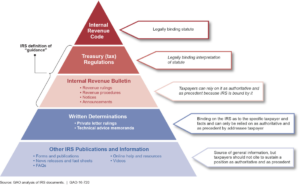
The GAO report: (1) analyzed documents that defined IRS guidance types; (2) reviewed the IRS’s policies and procedures for issuing guidance; (3) reviewed literature on the IRS’s issuance of guidance; (4) interviewed individuals at relevant government and tax practitioner organizations; and (5) reviewed IRS guidance issued during 2013 through 2015. Below is a chart included in the GAO report that illustrates various forms of guidance, and the weight that the IRS says attaches to each.

GAO blog post

The GAO found that the IRS uses many different forms of guidance to communicate its interpretation of tax laws to the public, but considers only the Internal Revenue Bulletin (IRB) guidance to be authoritative. The IRS’s statement that only IRB guidance is authoritative could be considered an oversimplification. We previously wrote (here, here, and here) about how deference principles may apply to various forms of guidance.

The GAO found further that while the IRS has detailed procedures for identifying, prioritizing, and issuing new guidance, the IRS lacks procedures for documenting the decision about what form of guidance to issue.

(more…)


read more

3M Company, IRS File Reply Briefs in “Blocked Income” Case; Tax Court Orders Oral Argument

As discussed in an earlier post, 3M Co. v. Commissioner, T.C. Dkt. No. 5816-13, involves 3M Company’s (3M) challenge to the Internal Revenue Service’s (IRS) determination that Brazilian legal restrictions on the payment of royalties from a subsidiary in that country to its US parent should not be taken into account in determining the arm’s-length royalty between 3M and its subsidiary under Treas. Reg. § 1.482-1(h)(2). The case has been submitted fully stipulated under Tax Court Rule 122. We discussed the parties’ opening briefs, filed on March 21, 2016, here. Reply briefs were filed on June 29, with the IRS filing an amended reply brief on August 18.

3M returns to its argument that Treas. Reg. § 1.482-1(h)(2) is “procedurally invalid” because Treasury and the IRS failed to satisfy the requirements of section 553 of the Administrative Procedure Act (the APA) when they promulgated the regulations. 3M notes that the IRS completely ignored this argument in its opening brief. Citing the Supreme Court’s recent opinion in Encino Motorcars, discussed in more detail here, 3M points out that Treasury and the IRS made significant changes to the regulation, but offered no explanation for the changes. This, 3M argues, renders the regulation invalid. 3M observes that compliance with the two-step Chevron test would not save a regulation that is procedurally invalid, noting that such compliance is “a necessary but not a sufficient condition for a regulation to be upheld.”

(more…)


read more

IRS Begins Formal Assessment of CAP Program

On August 26, the Internal Revenue Service (IRS) announced that its Large Business & International (LB&I) division is in the process of assessing the Compliance Assurance Process (CAP) program. CAP is a real-time audit program that seeks to resolve the tax treatment of all or most return issues before the tax return is filed.  CAP began as a pilot program in 2005 with 17 taxpayers and has grown to currently include 181 taxpayers. In 2011, the CAP program was made permanent and expanded to include Pre-Cap and Compliance Maintenance. Pre-Cap provides interested taxpayers with a roadmap of the steps required for gaining entry into CAP, which as noted above is the standard real-time audit program whereby the IRS examines relevant transactions and proposed reporting positions before the tax return is filed. Cap Maintenance is intended for taxpayers who have been in CAP, have fewer complex issues, and have a track record of working cooperatively and transparently with the IRS. Under this phase, there is a reduced level of review with respect to the pre-filing review and the post-filing examination.

We previously wrote about the potential death of the CAP program. Based on the recent announcement, it appears that CAP is now on its deathbed. The recent announcement states that no new taxpayers will be accepted into the CAP program for the 2017 application season that begins in September 2016, which means that only taxpayers currently in the CAP and Compliance Maintenance phases may continue in the program. No new Pre-Cap application will be accepted and taxpayers currently in pre-Cap will not be accepted into the CAP phase. However, taxpayers currently in the CAP phase may be moved into the Compliance Maintenance phase, as appropriate. The announcement is not surprising in light of recent reorganization changes by the IRS and shifts to a “campaigns” approach, which we have written about here and here. The announcement explains that the CAP assessment is necessary given the IRS’s limited resources and constraints, combined with a business need to evaluate existing IRS programs to ensure that they are aligned with LB&I’s strategic vision. We will continue to monitor developments on this front, but for now any taxpayers that were planning on applying for the CAP program will no longer have that opportunity.


read more

EDITOR IN CHIEF

STAY CONNECTED

TOPICS

ARCHIVES

jd supra readers choice top firm 2023 badge
US Tax Disputes Firm of the Year 2025
2026 Best Law Firms - Law Firm of the Year (Tax Law)