

Treasury Regulations
Subscribe to Treasury Regulations's Posts

Tax consulting firm permitted to challenge final micro-captive reporting regulations

Ryan, LLC v. Internal Revenue Service[1] is the latest example of success in overcoming procedural hurdles to challenge the validity of a US Department of the Treasury (Treasury) regulation. In a recent opinion, the US District Court for the Northern District of Texas held that:

  • Ryan has standing to challenge the validity of the Treasury’s final regulations[2] that require disclosure of certain transactions engaged in by businesses and their “micro-captive insurance companies” (MCICs).
  • Ryan sufficiently pleaded its claim that the final regulations under challenge were “arbitrary, capricious, an abuse of discretion, or otherwise not in accordance with law” and must be set aside under the Administrative Procedure Act (APA).[3]
  • The court’s opinion confirms that nontaxpayer actors may have standing to challenge Treasury regulations. The case is also another example of a plaintiff reaching the merits stage of a challenge to a Treasury regulation in the aftermath of Loper Bright v. Raimondo.[4]

Background

Ryan is an advisor to businesses seeking to establish and maintain MCICs. “Captive” insurance companies are specialized insurance companies that exist to insure the entities that own them. When the owning entities make premium payments to the captive, the premiums do not need to include commissions or other fees associated with traditional insurers, making captives an attractive option especially when coverage is unavailable or costly through traditional insurers. Certain small captive insurance companies, commonly called MCICs, qualify for favorable tax treatment. Under section 831(b), MCICs are not taxed on the first $2.2 million in premiums paid by their owner-insured. The Internal Revenue Service (IRS) has increased its scrutiny of the captive insurance industry because of concerns that these arrangements may be exploited for fraud and abuse.

The Treasury’s new regulations

Section 6707A requires the disclosure of certain “reportable transactions,” defined as transactions that, in the IRS’s determination, have a “potential for tax avoidance or evasion.” A “listed transaction” is a type of reportable transaction in which the taxpayer is presumed to have engaged in the transaction for the purpose of tax avoidance or evasion.[5] A “transaction of interest” is a reportable transaction designated by the IRS as having a potential for abuse but is not presumed abusive.[6] These designations create heavy reporting requirements by taxpayers and their advisors (e.g., Ryan).

Under the Treasury’s new regulations, a micro-captive insurance transaction is defined based on a loss ratio factor and a financing factor. The loss ratio factor is the ratio of the captive insurance company’s cumulative insured losses to the cumulative premiums earned over a specified period, typically the most recent 10 taxable years (or all years if less than 10). The financing factor refers to whether the captive insurance company participated in certain related-party financing arrangements within the most recent five taxable years, such as making loans or other transfers of funds to insureds, owners, or related parties. A transaction is classified as a “listed transaction” if the MCIC’s loss ratio is [...]

Continue Reading


read more
Supreme Court Justice Breyer Announces Upcoming Retirement—A Look Back at His Tax Opinion in Home Concrete

On January 27, 2022, Supreme Court of the United States Justice Stephen Breyer formally announced his retirement, effective when the Supreme Court breaks for summer recess in June or July later this year—after his successor has been nominated and confirmed. Justice Breyer has served on the Supreme Court since 1994 and is the second-most senior justice after Justice Clarence Thomas.

Although Justice Breyer did not author a substantial number of tax opinions, the ones he did author are extremely important and include:

This post focuses on the Home Concrete case.

Home Concrete involved a challenge to the validity of US Department of the Treasury (Treasury) regulations issued during litigation that purported to overrule existing case law. In a 5-4 opinion authored by Justice Breyer, the Supreme Court rejected both the government’s statutory interpretation of the “substantial omission from gross income” exception to the normal three-year statute of limitations and the interpretation advanced in retroactive regulations issued during pending litigation. In doing so, the Court first applied principles of stare decisis and adhered to its prior opinion in Colony, Inc. v. Commissioner, which interpreted almost identical statutory language from the predecessor statute. It then held that, because it already interpreted the statute, there is no longer any different interpretation that is consistent with that precedent and available for adoption by the agency.

The history and procedural background are fascinating, and some of the issues highlighted in the case, but not directly decided, have been—and continue to be—developed. Further background on the case can be found in our 2012 Tax Executive article, “Home Concrete: The Story Behind the IRS’s Attempt to Overrule the Judiciary and Lessons for the Future.

Practice Point: Home Concrete remains important today as there are several cases in the administrative and judicial pipeline involving challenges to tax reform and transfer pricing regulations. It is a must-read for any taxpayers who are currently, or are considering in the future, challenging the validity of Treasury regulations.

Andrew Roberson was one of the lawyers representing Home Concrete before the Supreme Court.


read more

IRS Announces Nonacquiescence in Mayo Tax Regulation Invalidity Holding

We previously wrote here and here about decisions made by the District Court of Minnesota and the US Court of Appeals for the Eighth Circuit in Mayo Clinic v. United States regarding challenges to the validity of certain Treasury Regulations promulgated under Internal Revenue Code (Code) Section 170. In that case, the Eighth Circuit held for the taxpayer in part and the government in part and remanded to the district court to further develop the record and address certain issues.

The Internal Revenue Service (IRS) recently announced in an Action on Decision (AOD) that it will not acquiesce in the Eighth Circuit’s holding, which invalidated Treas. Reg. § 1.170A-9(c)(1)’s requirement that the primary function of an education organization described in Code Section 170(b)(1)(A)(ii) must be the presentation of formal instruction. This means that in all cases not appealable to the Eighth Circuit, the IRS will not follow this holding and will continue to litigate the issue.

The IRS’s policy is to announce at an early date whether it will follow the holdings in certain cases, and it does so by making an announcement in an AOD. A nonacquiescence is not binding on courts or the taxpayers but merely signals the IRS’s position that it disagrees with a court decision. (Sometimes the IRS will acquiesce in a decision.) Given that an AOD is published in the Internal Revenue Bulletin, it could be argued that the IRS’s action constitutes published guidance taxpayers can rely on. The IRS’s list of AODs, with links to each action, can be found here.


read more

IRS Is “All Hands on Deck” to Provide Guidance Related to Tax Reform

In the wake of tax reform, taxpayers and practitioners alike are anxious for guidance and clarification on how the new laws impact transactions and reporting positions. The Internal Revenue Service (IRS) has previously stated that implementing tax reform is its highest priority, but that issuing guidance on the entire bill would likely take a substantial amount of time. Since December 2017, the IRS has published a host of notices, revenue procedures and administrative guidance. In some instances, the guidance was mechanical (e.g., Notice 2018-38), and in others it was more substantive (e.g., Notice 2018-28, Notice 2018-18, Rev. Proc. 2018-26).

On May 31, 2018, the IRS announced an “all hands on deck” effort to implement tax reform through 11 groups working closely with the Treasury Department. The IRS originally stated that it did not plan to release any more proposed regulations before the end of the year. Instead, it would issue tax Forms (with instructions) that would need to be filed by taxpayers before the end of the year. On June 7, 2018, the IRS explained that it does plan to issue proposed regulations “covering all major portions” of the bill starting in September and ending in December 2018 (the IRS specifically plans to finalize the temporary aggregation regulations by September to stop them from sunsetting). The IRS reported it is in “very good shape” to meet these deadlines. Additionally, at a recent American Bar Association Section of Taxation meeting, IRS international counsel acknowledged year-end financial reporting for global companies and stated that international tax regulations are intended to be released in the fall instead of the end of the year. Regulations under Internal Code Section 965 are planned for issuance this summer, and other areas of guidance include global intangible low-tax income, also known as the GILTI tax.

(more…)


read more

GAO Reports on IRS Guidance Procedures

The United States Government Accountability Office (GAO) recently released a report regarding how the Internal Revenue Service (IRS) communicates tax guidance to the public.This report was prepared following bipartisan requests from members of both houses of Congress.

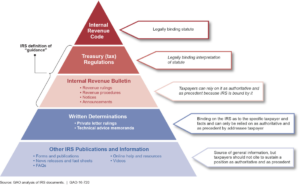
The GAO report: (1) analyzed documents that defined IRS guidance types; (2) reviewed the IRS’s policies and procedures for issuing guidance; (3) reviewed literature on the IRS’s issuance of guidance; (4) interviewed individuals at relevant government and tax practitioner organizations; and (5) reviewed IRS guidance issued during 2013 through 2015. Below is a chart included in the GAO report that illustrates various forms of guidance, and the weight that the IRS says attaches to each.

GAO blog post

The GAO found that the IRS uses many different forms of guidance to communicate its interpretation of tax laws to the public, but considers only the Internal Revenue Bulletin (IRB) guidance to be authoritative. The IRS’s statement that only IRB guidance is authoritative could be considered an oversimplification. We previously wrote (here, here, and here) about how deference principles may apply to various forms of guidance.

The GAO found further that while the IRS has detailed procedures for identifying, prioritizing, and issuing new guidance, the IRS lacks procedures for documenting the decision about what form of guidance to issue.

(more…)


read more

STAY CONNECTED

TOPICS

ARCHIVES

US Tax Disputes Firm of the Year 2025
2026 Best Law Firms - Law Firm of the Year (Tax Law)
jd supra readers choice top firm 2023 badge