

IRS Audits
Subscribe to IRS Audits's Posts

IRS Releases Several Transfer Pricing Directives

The Internal Revenue Service (IRS) Large Business and International (LB&I) Division recently released several directives (LB&I Directives) geared toward transfer pricing. LB&I acknowledges that significant LB&I resources are devoted to transfer pricing issues, and such issues make up a substantial portion of the LB&I inventory. It appears that these directives are aimed at ensuring that LB&I resources are utilized in the most efficient and effective manner on transfer pricing issues. A link to each LB&I Directive and a short summary is provided below.

Interim Instructions on Issuance of Mandatory Transfer Pricing Information Document Request (IDR) in LB&I Examinations

This LB&I Directive advises LB&I examiners that it is no longer necessary to issue the mandatory transfer pricing information document request (IDR) to taxpayers that have filed Form 5471, Information Return of U.S. Person with Respect To Certain Foreign Corporations, or Form 5472, Information Return of a 25% Foreign-Owned U.S. Corporation or a Foreign Corporation Engaged in a U.S. Trade or Business, or engaged in cross-border transactions. An update to Part 4.60.8 of the Internal Revenue Manual will be made in the future to further explain this change. (more…)


read more
IRS Releases International Tax Guidance

Happy New Year to all our readers! To start off the New Year, the Internal Revenue Service (IRS) has released two pieces of guidance on international tax issues which are noteworthy. Each is briefly discussed below.

The first piece of guidance is Notice 2018-7, which announces the IRS’s intent to issue regulations for determining amounts included in gross income by a United States shareholder under Internal Revenue Code (Code) Section 951(a)(1) by reason of Code Section 965. The IRS has requested comments on the Notice and has indicated that it expects to issue additional guidance under Code Section 965.

The second piece of guidance is a Practice Unit on the substantial contribution test for the controlled manufacturing exception under the Code Section 954 regulations. This Practice Unit discusses the substantial contribution test and provides insight into the IRS’s approach in analyzing this issue in examinations of taxpayers. We previously posted about the purpose of Practice Units here, but to briefly recap this type of guidance is intended as job aids and training materials for IRS employees. A complete list of Practice Units can be found here.


read more

Prepare for Examination Season

The tax bar is abuzz with the talk of tax reform. Clients are in modeling purgatory, trying to calculate its effects and plan for the future. Public accounting firms are suggesting how to accelerate deductions in 2017 to take advantage of the massive tax rate decline in 2018. Now more than ever, there are substantial economic incentives to accelerate deductions in 2017 and defer income until 2018. Yes, it’s beginning to look a lot like Christmas and the end to what bodes to be a historic year for federal tax!

Not to be a Grinch, but consider the following as you prepare for year end. If you attempt to accelerate any deductions, make sure to have a complete, “audit-ready” file if the Internal Revenue Service (IRS) decides to test your position. Consider how you will protect against the assertion of any penalties; typically, your ticket to get of out penalty “prison” is to maintain proper substantiation and to establish a reasonable cause defense. An opinion of counsel is one method to meet your burden of establishing that defense. It is always better to be proactive and anticipate an IRS audit than to be reactive and try to compile the proper documentation after-the-fact.


read more

Maintaining Confidentiality While Navigating Cross-Border Transactions

Today, taxing authorities across the globe, including the Internal Revenue Service (IRS), are increasing their efforts to gather and share sensitive taxpayer information, often aggressively seeking copies of tax advice, opinions and analysis prepared by counsel and other advisors. In some situations, tax advisors specifically draft their advice to be shared with third parties, but frequently the IRS seeks advice that was always intended to be confidential client communications—for example, drafts and emails containing unfinished analysis and unguarded commentary. Sharing this latter type of advice could be problematic for taxpayers because such advice could be used as a road map for examiners during an audit and may mislead the IRS regarding the strength or weakness of a taxpayer’s reporting positions.

Last month, we spoke to tax executives at Tax Executives Institute forums in Houston and Chicago about the IRS’s increased use of treaty requests to obtain US taxpayers’ documents and information from international tax authorities. (more…)


read more

IRS Releases Two International Practice Units on APAs for Inbound and Outbound Tangible Goods Transactions

On November 6, 2017, the Internal Revenue Service (IRS) released two new International Practice Units (IPUs) relating to Advance Pricing Agreements (APAs) for inbound and outbound tangible goods transactions. The IPUs provide a summary of the APA process, the types of APAs, and the interpretation and impact of an APA. The IPUs focus on the APA analysis for inbound distributors and outbound distributors. As we have previously noted, this high-level guidance to field examiners signals the IRS’s continued focus on international tax issues.


read more

IRS Continues to Barrage Taxpayers with New Campaigns

On November 3, 2017, the Internal Revenue Service (IRS) Large Business and International (LB&I) division identified 11 new examination compliance “campaigns.” We have extensively discussed LB&I’s “campaign” examination process, including posts on Understanding LB&I “Campaigns” and Run for Cover – IRS Unveils Initial “Campaigns” for LB&I Audits.

The IRS identified the 11 new campaigns “through LB&I data analysis and suggestions from IRS compliance employees.” The new campaigns are:

  • Form 1120-F Chapter 3 and Chapter 4 Withholding Campaign
  • Swiss Bank Program Campaign
  • Foreign Earned Income Exclusion Campaign
  • Verification of Form 1042-S Credit Claimed on Form 1040NR
  • Agricultural Chemicals Security Credit Campaign
  • Deferral of Cancellation of Indebtedness Income Campaign
  • Energy Efficient Commercial Building Property Campaign
  • Corporate Direct (Section 901) Foreign Tax Credit
  • Section 956 Avoidance
  • Economic Development Incentives Campaign
  • Individual Foreign Tax Credit (Form 1116)

Practice Point:  The IRS’s salvo represents the “second wave” of LB&I’s issue-focused compliance work.  Indeed, the IRS noted that “[m]ore campaigns will continue to be identified, approved and launched in the coming months.” It is clear that the IRS is focusing its resources on these campaigns, and has developed significant internal expertise on these issues. If you have one of the identified issues, consider being proactive and preparing an audit ready-file as the issue will likely be examined.


read more

Tax Court Says IRS’s “Drift-Net” Argument to Expand Privilege Waiver Must Be Anchored in Principles

In Estate of Levine v. Commissioner, the US Tax Court (Tax Court) rejected an Internal Revenue Service (IRS) attempt to expand upon the privilege waiver principles set forth in AD Inv. 2000 Fund LLC v. Commissioner. As background, the Tax Court held in AD Investments that asserting a good-faith and reasonable-cause defense to penalties places a taxpayer’s state of mind at issue and can waive attorney-client privilege. We have previously covered how some courts have narrowly applied AD Investments.

In Estate of Levine, the IRS served a subpoena seeking all documents that an estate’s return preparer and his law firm had in their files for a more-than-ten-year period, beginning several years before the estate return was filed and ending more than four years after a notice of deficiency (i.e., which led to the Tax Court case) was issued. The law firm prepared the estate plan and the estate tax return in issue. The law firm represented the estate during the audit, and after the notice of deficiency was issued, the law firm was engaged to represent the estate in “pending litigation with the IRS.”   (more…)


read more

Statutes of Limitation in the International Tax Context

As most taxpayers know, under Internal Revenue Code (Code) Section 6501(a), the Internal Revenue Service (IRS) generally has three years after a tax return is filed to assess any additional tax. However, Code Section 6501 provides several exceptions to this rule, including but not limited to the following.

  • False or fraudulent returns with the intent to evade tax (unlimited assessment period)
  • Willful attempt to defeat or evade tax (unlimited assessment period)
  • Failure to file a return (unlimited assessment period)
  • Extension by agreement (open-ended or for a specific period)
  • Adjustments for certain income and estate tax credits (separately provided in specific statutes)
  • Termination of private foundation status (unlimited assessment period)
  • Valuation of gifts of property (unlimited assessment period)
  • Listed transactions (assessment period remains open for one year after certain information is furnished)
  • Substantial omission of items (six-year assessment period)
  • Failure to include certain information on a personal holding company return (six-year assessment period)

If the IRS issues a notice of deficiency and the taxpayer files a petition in the Tax Court, the statute of limitations on assessment is extended until after the Tax Court’s decision becomes final. See Code Section 6503(a); see also Roberson and Spencer, “11th Circuit Allows Invalid Notice to Suspend Assessment Period,” 136 Tax Notes 709 (August 6, 2012). (more…)


read more

TIGTA Report: FOIA Procedures Need Improvement

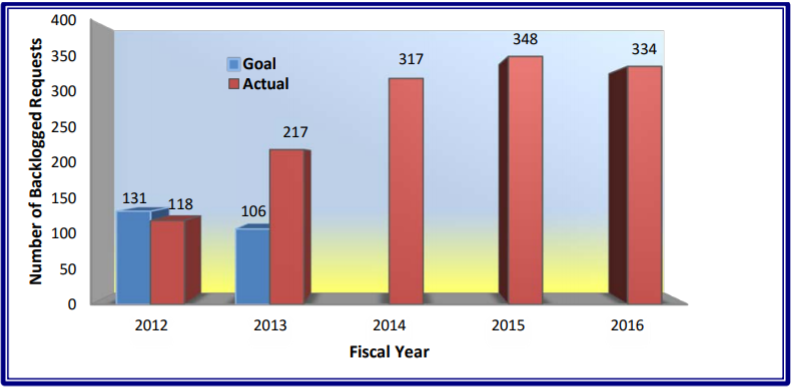
On September 7, 2017, the Treasury Inspector General for Tax Administration (TIGTA) issued a report about the Internal Revenue Service’s (IRS) Freedom of Information Act (FOIA) procedures. After reviewing a statistically valid sample of FOIA requests, TIGTA concluded that the IRS improperly withheld information 14.3 percent of the time—or approximately 1 in 7 FOIA requests.

TIGTA also found that at the end of Fiscal Year 2016, there were 334 backlogged information requests. Below is a chart from the report showing the IRS’s recent history of backlogged FOIA requests.

TIGTA’s findings are consistent with our experiences with FOIA requests. It is not unusual for the IRS to make repeated requests for extensions to respond. We note further that, during an examination, the IRS is statutorily authorized to provide taxpayers access to their administrative file. Indeed, the Internal Revenue Manual confirms this at section 4.2.5.7 (June 15, 2017). Yet the IRS examination team often requires a FOIA request.

Practice Point 1: As a result of the IRS’s FOIA backlog, some taxpayers have resorted to filing lawsuits in federal district court to enforce their FOIA rights. Because the IRS must respond to court deadlines, taxpayers are sometimes able to force a more expedient response and move to the front of the response line.

Practice Point 2: Taxpayers should attempt to tailor their FOIA requests, only requesting the information in which they are interested. In theory, this could make the IRS’s job easier and, in turn, responses more timely.

Practice Point 3: If taxpayers intend to seek information from the government through the FOIA process, they should do so as soon as possible (e.g., at the beginning of the examination process) so that they may get the information in time to be useful.


read more

STAY CONNECTED

TOPICS

ARCHIVES

US Tax Disputes Firm of the Year 2025
2026 Best Law Firms - Law Firm of the Year (Tax Law)
jd supra readers choice top firm 2023 badge