
On April 3, 2023, the US Tax Court issued its opinion in Farhy v. Commissioner, holding that the Internal Revenue Service (IRS) lacked the statutory authority to both assess tax penalties under Internal Revenue Code (Code) Section 6038(b) and collect said penalties via a levy against the taxpayer.
The decision in Farhy is significant because the IRS regularly assesses civil tax penalties for the late filing of international information return forms, such as Form 5471, Information Return of US Persons with Respect to Certain Foreign Corporations. Moreover, for any taxpayer who paid a penalty for filing Form 5471 late, arguably the assessment of that penalty was improper, and the taxpayer may be able to seek a refund of the penalty paid.
Announcement 2023-10: This announcement was issued pursuant to the Ticket to Work and Work Incentives Improvement Act of 1999, which requires the US Secretary of the Treasury to annually report advance pricing agreements and the Advance Pricing and Mutual Agreement Program (APMA Program). This year’s report describes the experience, structure and activities of the APMA Program during 2022.
REG-105954-22: This notice provides guidance related to Sections 4661, 4662, 4671 and 4672, collectively referred to as the Superfund chemical taxes. Section 4661(a) imposes an excise tax on the sale or use of “taxable chemicals” by manufacturers, producers or importers. Section 4671(a) imposes an excise tax on the sale or use of “taxable substances” by importers. The Superfund chemical taxes previously expired on December 31, 1995, but were reinstated with certain modifications, effective July 1, 2022, by Section 80201 of the Infrastructure Investment and Jobs Act.
Notice 2023-31: This notice announces that when proposed regulations under Section 903 (REG-112096-22) are finalized, the US Department of the Treasury and the IRS intend to extend the transition period for the single-country exception’s documentation requirement from May 17, 2023, to 180 days after the final regulations are filed. The single-country exception provides relief from the source-based attribution requirement under Section 903 for foreign withholding taxes on royalties paid for the use of intellectual property within the withholding jurisdiction.
REG-120080-22: This document contains proposed regulations regarding the clean vehicles credit under Section 30D. These proposed regulations will affect persons seeking to claim the credit and qualified manufacturers of clean vehicles. The IRS also issued a reminder that the proposed regulations went into effect on April 18.
Revenue Ruling 2023-2: This revenue ruling confirms that the basis adjustment under Section 1014 generally does not apply to the assets of an irrevocable grantor trust not included in the deceased grantor’s gross estate for federal estate tax purposes.
April 17, 2023: The IRS released Revenue Ruling 2023-9, which provides the applicable federal rates for federal income tax purposes for May 2023. The short-term federal interest rate is 4.30%, the mid-term rate will drop to 3.57% and the long-term rate will fall to 3.72%.
April 17, 2023: The IRS reminded taxpayers who need additional time to file their taxes that they can get an extension via IRS Free File.
April 17, 2023: The IRS released Tax Tip 2023-51, providing information to taxpayers regarding how to file a final federal tax return for someone who has died.
April 17, 2023: The IRS reminded last-minute tax [...]
Revenue Procedure 2023-20: This revenue procedure modifies the effective date of additions to the taxable substances or chemicals list under Section 4672(a). Specifically, this revenue procedure changes the date on which substances are added to the list for purposes of refund claims under Section 4662(e).
Notice 2023-27: This notice announces that the US Department of the Treasury and the IRS intend to issue guidance related to the tax treatment of certain non-fungible tokens (NFTs). The guidance requests comments on the treatment of NFTs as collectibles and describes how the IRS intends to determine whether an NFT is a collectible until further guidance is issued.
Notice 2023-28: This notice extends temporary relief regarding deposits of the excise tax imposed on certain chemicals under Section 4661 and the excise tax imposed on certain imported chemical substances under Section 4671 (collectively, Superfund chemical taxes). The extended relief is available in connection with deposits of the Superfund chemical taxes for semimonthly periods in the second, third and fourth calendar quarters of 2023.
REG-120653-22: These proposed regulations implement the advanced manufacturing investment credit, a new current-year business tax credit under Section 48D to incentivize the manufacture of semiconductors and semiconductor manufacturing equipment within the United States. The regulations address the credit’s eligibility requirements, an election that eligible taxpayers may make to be treated as making a payment of tax (including an overpayment of tax) or for an eligible partnership or S corporation to receive an elective payment instead of claiming a credit, and a special 10-year credit recapture rule that applies if there is a significant transaction involving the material expansion of semiconductor manufacturing capacity in a foreign country of concern.
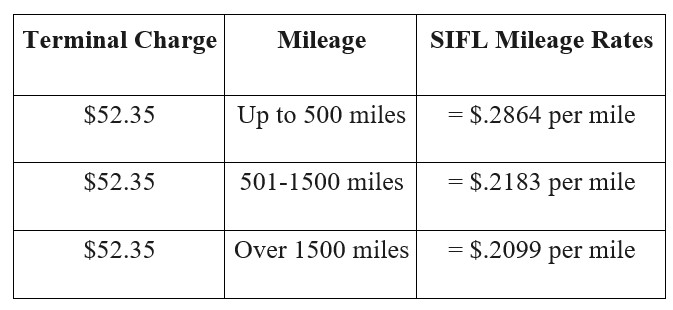
Revenue Ruling 2023-7: This revenue ruling provides the fringe benefits aircraft valuation formula. For purposes of Section 1.61-21(g) of the regulations, relating to the rule for valuing non-commercial flights on employer-provided aircrafts, the Standard Industry Fare Level (SIFL) cents-per-mile rates and terminal charge in effect for the first half of 2023 are as follows:
April 10, 2023: The IRS released Tax Tip 2023-47, providing guidance on when to file an amended income tax return.
April 10, 2023: The IRS and the Treasury issuedNotice 2023-30, providing safe harbor deed language for extinguishment and boundary line adjustment clauses as required by the SECURE 2.0 Act of 2022. Section 605(d)(2) provides donors with the opportunity to amend certain conservation easement deeds to substitute the [...]
Notice 2023-25: This notice provides guidance on the corporate bond monthly yield curve, the corresponding spot segment rates and the 24-month average segment rates. It also provides guidance as to the interest rate on 30-year Treasury securities as in effect for plan years beginning before 2008 and the 30-year Treasury weighted average rate.
Revenue Ruling 23-6: This revenue ruling provides the applicable federal rates for federal income tax purposes for April 2023. The annual short-term rate is 3.67%, the mid-term rate is 3.14% and the long-term rate is 3.04%.
April 3, 2023: The IRS released Notice 2023-31, announcing an Extension of the Transition Period for the Single-Country Exception Under Section 903.
April 3, 2023: The IRS announced special Saturday hours at Taxpayer Assistance Centers. The final Saturday opening will be May 13, 2023, from 9:00 am to 4:00 pm.
April 3, 2023: The IRS released the last entry in its Dirty Dozen campaign, cautioning taxpayers to beware of promoters peddling bogus tax schemes aimed at reducing or avoiding taxes.
April 3, 2023: The IRS announced that Arkansas storm victims now have until July 31, 2023, to file various federal individual and business tax returns and make tax payments as a result of storms that occurred on March 31, 2023. Relief is available to anyone in an area designated by the Federal Emergency Management Agency as qualifying for individual or public assistance. The current list of eligible localities is available here.
April 3, 2023: The IRS reminded taxpayers that tax credits are available for a portion of the qualifying expenses related to energy improvements to their homes. Taxpayers can claim either the Energy Efficient Home Improvement Credit or the Residential Energy Clean Property Credit for the year when qualifying improvements are made.
April 3, 2023: The IRS released Tax Tip 2023-43, reminding taxpayers that IRS.gov has tax information in seven languages: Spanish, Chinese Traditional, Chinese Simplified, Korean, Russian, Vietnamese and Haitian Creole.
April 4, 2023: The IRS released Revenue Procedure 2023-12, which updates the procedures for exempt organizations determination letters with respect to the electronically submitted Form 8940, Request for Miscellaneous Determination. This modification to Revenue Procedure 2023-5 provides that the electronic submission process is the exclusive means of submitting a completed Form 8940, except for submissions eligible for the 90-day transition relief.
April 4, 2023: The IRS announced guidance related to the eligibility requirement for energy communities for the bonus credit program under the Inflation Reduction Act of 2022 (IRA). Notice 2023-29 describes certain [...]
On April 3, 2023, the US Tax Court issued its opinion in Farhy v. Commissioner, ruling that the Internal Revenue Service (IRS) could neither assess tax penalties under Internal Revenue Code (Code) Section 6038(b) against Alon Farhy nor collect those penalties via a levy.
This is a significant development because the IRS automatically assesses these penalties on any late-filed Form 5471, Information Return of US Persons with Respect to Certain Foreign Corporations. This practice will presumably be immediately ceased. Moreover, any taxpayer who was assessed and paid a penalty on a late-filed Form 5471 may be able to obtain a refund on the penalty paid.
Farhy had failed to file Form 5471 with his US federal income tax return. Failure to timely file Form 5471 comes with a civil tax penalty of $10,000 for each year. (See IRC Section 6038(b)(1).) If the IRS sends the taxpayer notice of its failure to file Form 5471, the taxpayer has 90 days after the notice is mailed to comply with the filing requirement. Failure to comply within the 90-day period subjects the taxpayer to an additional penalty of $10,000 for each 30-day period, with a $50,000 maximum. (See IRC Section 6038(b)(2).)
Code Section 6201(a) permits the IRS to “assess” taxes and assessable penalties. Assessment is the act of formally recording a tax liability on the IRS’s records for a taxpayer. After assessment and failure to pay, the IRS can enforce the collection of tax, penalties and interest by asserting a lien on property or by levying (taking) property.
The Code provides statutes that permit the IRS to assess taxes (including interest, additional amounts and additions to tax) and certain types of penalties (assessable penalties). In Farhy, the Tax Court held that the Code does not contain any statute that permits the IRS to assess the penalty provided in Code Section 6038(b). As such, although the IRS correctly determined that Farhy should be penalized for failing to file Form 5471 with his return, the IRS lacked the statutory ability under the Code to assess and collect the penalty under traditional assessment and collection procedures that they use for other penalties (essentially treated similar to deemed taxes).
The Tax Court did note that the government had other tools at its disposal to collect the penalties, for example, 28 U.S.C. § 2461(a): “Whenever a civil fine, penalty or pecuniary forfeiture is prescribed for the violation of an Act of Congress without specifying the mode of recovery or enforcement thereof, it may be recovered in a civil action.”
Practice Point:Farhy is a major taxpayer victory and demonstrates that a technical deficiency in the Code can have substantial ramifications for the administration of our tax laws and the potential collection of penalties relating to violations thereof. Clearly, Congress intended to permit the IRS the ability to collect the penalties determined under the Code but failing to connect Code Section 6038(b) with the statutory provisions to assess tax and penalties makes the IRS unable to practically and efficiently collect said penalties. We expect (and are [...]
Notice 2023-23: This notice provides guidance to financial institutions on reporting required minimum distributions (RMDs) for 2023 after the amendment to Section 401(a)(9) made by the Consolidated Appropriations Act, 2023. If an individual retirement account (IRA) owner has an RMD due in 2023, the financial institution that is the trustee, custodian, or issuer maintaining the IRA must file a 2022 Form 5498 (IRA Contribution Information) by May 31, 2023, and indicate by checking Box 11 that an RMD is required.
Revenue Procedure 2023-13: This procedure provides the general rules and specifications for paper and computer-generated substitutes for the following:
Form 941, Employer’s QUARTERLY Federal Tax Return
Schedule B (Form 941), Report of Tax Liability for Semiweekly Schedule Depositors
Schedule D (Form 941), Report of Discrepancies Caused by Acquisitions, Statutory Mergers, or Consolidations
Schedule R (Form 941), Allocation Schedule for Aggregate Form 941 Filers
Form 8974, Qualified Small Business Payroll Tax Credit for Increasing Research Activities.
Revenue Procedure 2023-18: This procedure addresses how to apply to be a certified professional employer organization (CPEO), the requirements for a CPEO to remain certified and the procedures relating to suspension and revocation of CPEO certification.
Notice 2023-24: This notice provides guidance under Section 45J relating to the credit for the production of electricity from advanced nuclear power facilities. The notice provides (1) guidance for computing the Section 45J credit; (2) the amount of the unutilized national megawatt capacity limitation; (3) the procedures for taxpayers to apply for allocations of—and that the IRS will use to allocate—the unutilized national megawatt capacity limitation solely with respect to facilities that the US Department of Energy previously certified as “advanced nuclear facilities” and (4) the procedures for a “qualified public entity” to elect to transfer the Section 45J credit to an “eligible project partner.”
Notice 2023-26: This notice provides adjustments to the limitation on housing expenses for purposes of Section 911 for specific locations for 2023. These adjustments are based on geographic differences in housing costs relative to housing costs in the United States.
Revenue Procedure 2023-17: This procedure provides indexing adjustments for the applicable dollar amounts under Sections 4980H(c)(1) and (b)(1). These indexed amounts are used to calculate the employer-shared responsibility payments under Section 4980H(a) and (b)(1), respectively.
Revenue Procedure 2023-19: This procedure provides information to any individual who failed to meet Section 911(d)(1) eligibility requirements for 2022 because of adverse conditions in a foreign country.
March 27, 2023: The IRS released a warning as part of the [...]
Notice 2023-22: This notice advises state and local housing credit agencies that allocate low-income housing tax credits under Section 42, as well as states and other issuers of tax-exempt private activity bonds under Section 141, of the population figures to use in calculating the (1) state housing credit ceiling under Section 42(h), (2) private activity bond volume cap under Section 146 and (3) private activity bond volume limit under Section 142(k).
March 20, 2023: The IRS announced tips to avoid processing delays and refund adjustments as the April 18, filing deadline approaches. The tips include gathering all tax documents, filing electronically, using the correct filing status, double-checking names and social security numbers, answering the digital assets question and reporting all taxable income.
March 20, 2023: The IRS announced a new entry into the annual Dirty Dozen list of tax scams: promoter claims involving the Employee Retention Credit (ERC). Some third parties continue to widely advertise services that target taxpayers who may not be eligible for the ERC. The advertisements, along with the increased prevalence of websites touting how easy it is to qualify for the ERC, suggest that the abusive claims may be legitimate. The annual list of schemes is aimed at raising awareness of aggressive promoters and con artists. These schemes put people at financial risk and increase the chances of identity theft.
March 20, 2023: The IRS released Tax Tip 2023-35, providing options for taxpayers who cannot pay their tax bill by April 18. The IRS also reminded taxpayers to still file their tax returns even if they cannot pay to avoid a failure-to-file penalty.
March 21, 2023: The IRS announced that it is requesting feedback regarding the tax treatment of a non-fungible token (NFT) as a collectible under the tax law in Notice 2023-27. An NFT is a unique digital identifier that is recorded using distributed ledger technology and may be used to certify the authenticity and ownership of an associated right or asset. The guidance also requests comments on the treatment of NFTs as collectibles and describes how the IRS intends to determine whether an NFT is a collectible until further guidance is issued.
March 21, 2023: The IRS issuedproposed regulations that provide guidance on the implementation of the Advanced Manufacturing Investment Credit, established by the Creating Helpful Incentives to Produce Semiconductors Act of 2022 (CHIPS Act). The credit incentivizes the manufacture of semiconductors and semiconductor manufacturing equipment within the United States.
March 21, 2023: The IRS cautioned taxpayers to watch out for scammers using email and text messages to [...]
Notice 2023-21: This notice postpones the beginning of the lookback periods under Section 6511 for certain taxpayers to file a claim for refund. Affected taxpayers include those who had tax returns due from April 15, 2020 to July 15, 2020, or from April 15, 2021 to May 17, 2021, and due to the COVID-19 pandemic, those due dates were postponed by Notice 2020-23 or Notice 2021-21 to July 15, 2020 or May 17, 2021, respectively.
Treasury Decision 9972: These final regulations amend the rules for filing certain returns and statements electronically to reflect changes made by the Taxpayer First Act of 2019 and to promote electronic filing.
Notice 2023-19: This notice provides guidance on the corporate bond monthly yield curve, corresponding spot segment rates and the 24-month average segment rates for February 2023. The notice also provides guidance as to interest rates on 30-year Treasury securities and 30-year Treasury weighted average rates.
REG 122286-18: These proposed regulations provide rules relating to the use of forfeitures in qualified retirement plans, including a deadline for the use of forfeitures in defined contribution plans, and clarify that forfeitures arising in any defined contribution plan may be used for one or more of the following purposes, as specified in the plan, to (1) pay plan administrative expenses, (2) reduce employer contributions under the plan or (3) increase benefits in other participants’ accounts in accordance with plan terms.
Action on Decision 2023-2: The IRS announced nonacquiescence to the US Tax Court’s decision in Complex Media, Inc. v. Commissioner, T.C. Memo. 2021-14, that the parties’ failure to report transactions fully or consistently should not be a major factor in a decision of whether to allow a taxpayer to disavow the form of its transactions and to the standard the Court applied to allow a petitioner to disavow its form. The IRS also announced nonacquiescence to the court’s determination that the fair market value of a “Deferred Payment Right” for purposes of Section 351(b)(1) is not equal to its issue price.
Treasury Decision 9973: This document contains final regulations that treat members of a consolidated group as a single US shareholder in certain cases for purposes of Section 951(a)(2)(B). The final regulations affect consolidated groups that own stock of foreign corporations.
March 13, 2023: The IRS announced that Danny Werfel began work as the 50th Commissioner of the IRS. Werfel was confirmed by the US Senate on March 9, 2023, and his term will run through November 12, 2027. You can read more about his confirmation Continue Reading
Action on Decision 2023-1: The IRS announced that although it disagrees with the holding that Section 4611(b)(1)(A) imposes a tax on exports in violation of the Export Clause of the US Constitution (US Const. art. I, § 9, cl. 5), in the interest of sound tax administration, it will follow the decision in all circuits.
Notice 2023-17: This notice establishes a program to allocate amounts of environmental justice solar and wind capacity limitation (Capacity Limitation) to qualified facilities eligible for the energy investment credit as determined under Section 48. This notice also provides initial program guidance for potential applicants for allocations of calendar year 2023 Capacity Limitation.
Notice 2023-18: This notice establishes the Section 48C(e)(1) program to allocate $10 billion in credits ($4 billion of which may only be allocated to projects located in certain energy communities census tracts) and provides initial guidance. The goal of the program is to expand US manufacturing capacity and quality jobs for clean energy technologies (including production and recycling), reduce greenhouse gas emissions in the US industrial sector and secure domestic supply chains for critical materials (including specified critical minerals) that serve as inputs for clean energy technology production.
Notice 2023-20: This notice provides interim guidance for the determination of adjusted financial statement income as it relates to (1) variable contracts and similar contracts, (2) funds withheld from reinsurance and modified coinsurance agreements and (3) the basis of certain assets held by certain previously tax-exempt entities that received a “fresh start” basis adjustment.
Revenue Ruling 2023-5: This revenue ruling provides the applicable federal rates for federal income tax purposes for March 2023. The short-term federal interest rate is 4.5%, the mid-term rate is 3.7% and the long-term rate is 3.74%.
March 6, 2023: The IRS announced that it will be open for special Saturday hours throughout tax season, during which taxpayers can receive face-to-face help from IRS employees without an appointment. The next Saturday openings will be April 8 and May 13.
March 6, 2023: The IRS released Tax Tip 2023-28, which offers easy and convenient options for making federal tax payments.
March 7, 2023: The IRS released Notice 2023-23, which provides guidance to financial institutions on reporting required minimum distributions (RMDs) for 2023 after the amendment to Section 401(a)(9) made by the Consolidated Appropriations Act. If an individual retirement account (IRA) owner has an RMD due for 2023, the financial institution that is the trustee, custodian or issuer maintaining the IRA must file a 2022 Form 5498 (IRA Contribution Information) by May 31, 2023, and indicate [...]
Check out our summary of significant Internal Revenue Service (IRS) guidance and relevant tax matters for the week of February 27, 2023 – March 3, 2023.
Revenue Ruling 2023-4: This revenue ruling establishes the interest rates on tax overpayments and underpayments for the second quarter of 2023. As of April 1, 2023, the rates will be as follows:
Overpayments: 7%
Overpayments for corporations: 6%
Corporate overpayments for portion exceeding $10,000: 4.5%
Underpayments: 7%
Large corporate underpayments: 9%
Announcement 2023-6: This announcement notifies the public that the IRS intends to issue opinion letters by February 28, 2023, for pre-approved defined benefit plans that were updated for changes in plan qualification requirements and filed with the IRS during the third six-year remedial amendment cycle. This announcement also notifies the public of the date by which an adopting employer intending to maintain a pre-approved defined benefit plan for the third six-year cycle must adopt a newly approved plan and announces the beginning and ending dates of the period during which, an adopting employer may file for an individual determination letter.
February 27, 2023: The IRS released Notice 2023-21, which provides relief under Section 7508A(a) for certain persons affected by COVID-19 by disregarding the period beginning on April 15, 2020, and ending on July 15, 2020, in determining the beginning of the lookback period. Under the relief, if a taxpayer files a claim for credit or refund on or before June 22, 2023, the lookback period extends three years back from the date of the claim, disregarding the period from April 15, 2020, to July 15, 2020. As a result, the limit to the amount of the credit or refund would include the taxpayer’s withheld income taxes deemed paid on April 15, 2020. Relief is automatic.
February 27, 2023: The IRS released Tax Tip 2023-24, highlighting Tax Pro Account, which lets tax professionals submit an authorization request to a taxpayer’s IRS Online Account, including both power of attorney and tax information authorization requests. Taxpayers can then review, approve and sign the request electronically.
February 28, 2023: The IRS reminded farmers and fishers who did not pay all their 2022 estimated taxes by January 17 that they must file their 2022 tax return and pay the entire tax due by March 1. Disaster-area taxpayers, including farmers and fishers, have more time to file and pay.
February 28, 2023: The IRS released Tax Tip 2023-25, providing guidance on what to do when a W-2 or Form 1099 is missing or incorrect.
March 1, 2023: The IRS reminded taxpayers of their reporting and potential tax obligations on income from the gig economy and service industry, transactions from digital assets and foreign sources or holding certain foreign assets. The gig [...]