

IRS
Subscribe to IRS's Posts

Weekly IRS Roundup August 20 – 24, 2018

Presented below is our summary of significant IRS guidance and relevant tax matters for the week of August 20 – 24, 2018:

August 21, 2018: The IRS and Treasury released Notice 2018-67, which provides guidance regarding separately calculating the unrelated business taxable income (UBTI) of each trade or business conducted by a tax-exempt entity. Section 512(a)(6), enacted as part of tax reform, requires this separate calculation by tax-exempt organizations with more than one unrelated trade or business.

August 21, 2018: The IRS and Treasury released Notice 2018-68, which provides guidance regarding new section 162(m). Section 162(m), enacted as part of tax reform, limits the deduction for compensation paid by a publicly traded corporation to a covered employee. The notice provides guidance regarding the “grandfather” exception for certain compensation arrangements in effect on November 2, 2017. See our commentary for more information.

August 22, 2018: The IRS released Revenue Procedure 2018-44, which provides guidance regarding accounting method changing resulting from the revocation or termination of an entity’s S corporation status. Revenue Procedure 2018-44 adds such accounting method changes to the list of “automatic changes” listed in Revenue Procedure 2018-31.

August 22, 2018: The IRS published a draft Form 8992 for computing global low-taxed intangible income and a draft Form 8993 for computing foreign derived intangible income.

August 23, 2018: The IRS published proposed regulations providing guidance regarding the availability of a charitable deduction when the taxpayer also receives (or expects to receive) a state or local tax credit for the contribution.

August 24, 2018: The IRS made it clear that US citizens and residents that are contractors or employees of contractors supporting US Armed Forces are eligible for the section 911 foreign earned income exclusion.

August 24, 2018: The IRS released its weekly list of written determinations (e.g., Private Letter Rulings, Technical Advice Memorandum and Chief Counsel Advice).

Special thanks to Kevin Hall in our DC office for this week’s roundup.


read more
IRS Issues Long-Awaited Initial Guidance under Section 162(m)

On August 21, 2018, the IRS issued guidance regarding recent statutory changes made to Section 162(m) of the Internal Revenue Code. Overall, Notice 2018-68 strictly interprets the Section 162(m) grandfathering rule under the Tax Cuts and Jobs Act.

Public companies and other issuers subject to these deduction limitations will want to closely consider this guidance in connection with filing upcoming periodic reports with securities regulators. Further action to support existing tax positions or adjustments to deferred tax asset reporting in financial statements may be warranted in light of this guidance.

Access the full article.


read more

OVDP Ending September 28: Now Is the Time to Disclose

Earlier this year, the Internal Revenue Service (IRS) announced the ending of the 2014 Offshore Voluntary Disclosure Program (OVDP), its formal amnesty program for taxpayers with previously undisclosed interests in foreign assets and financial accounts. The program deadline is September 28, 2018, and all submissions must be substantially completed by that deadline. Partial or “placeholder” submissions will not qualify. All requests for preclearance into the program must be submitted by Friday, August 24, 2018.

A number of other disclosure options will remain available after September 28, 2018, including the popular IRS streamlined compliance procedures. Regardless, taxpayers with potential questions or concerns regarding reporting of their foreign holdings should seek advice immediately in light of upcoming deadlines.


read more

Tax Reform Insight: IRS Slams Door on Refunds/Credits for Taxpayers with Section 965 Transition Tax Liability

The Internal Revenue Service (IRS) has issued PMTA 2018-016, reaffirming its position that for taxpayers making an election under Internal Revenue Code (Code) Section 965(h) to pay the transition tax over eight years through installment payments, any overpayments of 2017 tax liabilities cannot be used as credits for 2018 estimated tax payments or refunded, unless and until the overpayment amount exceeds the full eight years of installment payments.

The IRS’s position has affected many taxpayers, and practitioners expressed their concerns to the IRS to no avail.

Access the full article.


read more

Fifth Circuit Dismisses Anti-Inversion Regulation Case

We previously posted on the Order by the US District Court for the Western District of Texas in Chamber of Commerce of the United States of America, et al. v. Internal Revenue Service, Dkt. No. 1:16-CV-944-LY (W.D. Tex. Sept. 29, 2017). To recap, the district court held that Treas. Reg. § 1.7874-8T was unlawfully issued because it violated the Administrative Procedures Act (APA) by not providing affected parties with notice and an opportunity to comment on the temporary regulations. In addition to the APA analysis, the court’s Order was noteworthy for its conclusion that the plaintiff’s claims were not barred by the Anti-Injunction Act because the regulations did not involve assessment or collection of tax.

As we updated our readers, the government appealed the Order to the Court of Appeals for the Fifth Circuit. However, the case was stayed while the regulation underwent notice and comment. And, on July 11, 2018, Treasury and the Internal Revenue Service issued final regulations addressing inversion standards. On July 26, 2018, the government moved to dismiss its appeal with prejudice as moot. The Fifth Circuit has granted the government’s motion, thus ending the dispute.

Because the case was dismissed by the Fifth Circuit, the district court’s Order remains on the books. But what value does that Order have? As a technical matter, district court opinions are not precedential. However, lack of precedential value does not render the Order meaningless. If another court addressing a similar issue were to find the district court’s analysis to be well-reasoned and thorough, it might consider it persuasive on deciding the issue. One would certainly expect that a subsequent court would, at a minimum, have to address the Order if faced with a similar issue. For more reading on the precedential and persuasive value of opinions and order, see here.

Practice Point: The Order in the Chamber of Commerce case may be helpful to taxpayers desiring to challenge regulations on APA grounds and provides authority for a pre-enforcement challenge. It remains to be seen whether other courts will find the Order persuasive.


read more

IRS Releases Practice Unit on Examining Transaction Costs

On July 18, 2018, the Internal Revenue Service (IRS) released a Practice Unit advising IRS agents on the framework to follow in analyzing the tax treatment of transaction costs incurred by taxpayers in executing business practices. The latest Practice Unit provides guidance to IRS examiners in determining whether transaction costs must be capitalized or can be immediately deducted, and focuses on the so-called INDOPCO regulations contained in Treasury Regulation § 1.263-5. (For more information and background, see here.)

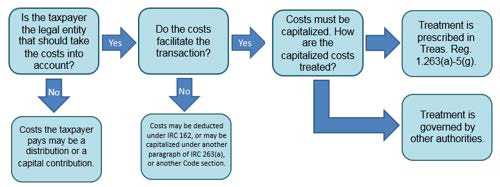
According to the Practice Unit, there is a three-step process applied to analyze a transaction costs issue:

  1. Determine whether the taxpayer is the proper legal entity to take the transaction costs into account for tax purposes;
  2. Determine whether the costs facilitate the transaction; and
  3. Determine how the taxpayer should treat facilitative costs it must capitalize.

The key considerations and outcomes for each step are illustrated in the Practice Unit as follows:

Practice Point: Determining whether transaction costs must be capitalized or can be deducted is sometimes a difficult process. The IRS has attempted to create bright-line rules in this area, but invariably there are factual situations not covered by the INDOPCO regulations and disputes that may arise. Understanding the IRS’s approach to examining transaction costs, as set forth in this Practice Unit, may assist taxpayers under examination in resolving these types of issues.


read more

Weekly IRS Roundup July 9 – 13, 2018

Presented below is our weekly roundup for July 9 – 13, 2018 on significant IRS matters.

July 9, 2018: The IRS released Internal Revenue Bulletin No. 2018-28 including: Notice 2018-48 (lists the population census tracts designated as qualified opportunity zones); Notice 2018-59 (provides two methods for taxpayers to begin construction for the investment tax credit under Section 48); Announcement 2018-11 (Office of Professional Responsibility [OPR] announces recent disciplinary sanctions); Rev. Rul. 2018-20 (rendering obsolete several previous revenue rulings); and Rev. Proc. 2018-35 (modifying Rev. Proc. 2018-31 regarding accounting methods for citrus plant replanting costs).

July 11, 2018: The IRS issued final regulations (T.D. 9834) addressing inversion transactions structured to avoid the purposes of sections 7874 and 367 and other post-inversion tax avoidance transactions.

July 13, 2018: The IRS issued proposed regulations (REG-103474-18) related to the Code section 6695(g) return preparer penalty amending previous guidance to reflect changes made by 2017 federal tax reform.

July 13, 2018: The IRS released it weekly list of written determination (e.g., Private Letter Rulings, Technical Advice Memorandum and Chief Counsel Advice).

Special thanks to Christy Vouri-Misso and Greg Berson in our DC office for this week’s roundup.


read more

LB&I Announces Five New Campaigns

On July 2, 2018, the Internal Revenue Service (IRS) Large Business and International (LB&I) Division announced the identification and selection of five new campaigns. These new campaigns follow the initial 13 campaigns announced on January 31, 2017, followed by 11 campaigns announced on November 3, 2017, 5 campaigns announced on March 13, 2018, and six campaigns announced on May 21, 2018.

The following are the five new LB&I campaigns by title and description:

  • Restoration of Sequestered AMT Credit Carryforward

LB&I is initiating a campaign for taxpayers improperly restoring the sequestered Alternative Minimum Tax (AMT) credit to the subsequent tax year. Refunds issued or applied to a subsequent year’s tax, pursuant to IRC Section 168(k)(4), are subject to sequestration and are a permanent loss of refundable credits. Taxpayers may not restore the sequestered amounts to their AMT credit carryforward. Soft letters will be mailed to taxpayers who are identified as making improper restorations of sequestered amounts. Taxpayers will be monitored for subsequent compliance. The goal of this campaign is to educate taxpayers on the proper treatment of sequestered AMT credits and request that taxpayers self-correct.

  • S Corporation Distributions

S Corporations and their shareholders are required to properly report the tax consequences of distributions. We have identified three issues that are part of this campaign. The first issue occurs when an S Corporation fails to report gain upon the distribution of appreciated property to a shareholder. The second issue occurs when an S Corporation fails to determine that a distribution, whether in cash or property, is properly taxable as a dividend. The third issue occurs when a shareholder fails to report non-dividend distributions in excess of their stock basis that are subject to taxation. The treatment streams for this campaign include issue-based examinations, tax form change suggestions, and stakeholder outreach.

  • Virtual Currency

US persons are subject to tax on worldwide income from all sources including transactions involving virtual currency. IRS Notice 2014-21 states that virtual currency is property for federal tax purposes and provides information on the US federal tax implications of convertible virtual currency transactions. The Virtual Currency Compliance campaign will address noncompliance related to the use of virtual currency through multiple treatment streams including outreach and examinations. The compliance activities will follow the general tax principles applicable to all transactions in property, as outlined in Notice 2014-21. The IRS will continue to consider and solicit taxpayer and practitioner feedback in education efforts, future guidance, and development of Practice Units. Taxpayers with unreported virtual currency transactions are urged to correct their returns as soon as practical. The IRS is not contemplating a voluntary disclosure program specifically to address tax non-compliance involving virtual currency.

  • Repatriation via Foreign Triangular Reorganizations

In December 2016, the IRS issued Notice 2016-73 which curtails the claimed “tax-free” repatriation of basis and untaxed CFC earnings [...]

Continue Reading


read more

News of Wayfair Decision Breaks during Tax in the City® New York

The first New York meeting of McDermott’s Tax in the City® initiative in 2018 coincided with the June 21 issuance of the US Supreme Court’s (SCOTUS) highly anticipated Wayfair decision. Just before our meeting, SCOTUS issued its opinion determining that remote sellers that do not have a physical presence in a state can be required to collect sales tax on sales to customers in that state. McDermott SALT partner Diann Smith relayed the decision and its impact on online retailers to a captivated audience. Click here to read McDermott’s insight about the decision.

The event also featured a CLE/CPE presentation on the ethical considerations relative to tax reform by Kristen Hazel, Jane May and Maureen O’Brien, followed by a roundtable discussion on recent tax reform insights led by Britt Haxton, Sandra McGill, Kathleen Quinn and Diann Smith. Below are a few takeaways from last week’s Tax in the City® New York:

  • Supreme Court Update: Wayfair – Jurisdiction to Tax – The 5-4 opinion concluded that the physical presence requirement established by the Court in its 1967 National Bellas Hess decision and reaffirmed in 1992’s Quill is “unsound and incorrect” and that “stare decisis can no longer support the Court’s prohibition of a valid exercise of the States’ sovereign power.” This opinion will have an immediate and significant impact on sales and use tax collection obligations across the country and is something every company and state must immediately and carefully evaluate within the context of existing state and local collection authority. Click here to read McDermott’s insight about the decision.
  • Tax Reform: Ethical Considerations – Because of tax reform, taxpayers face increased uncertainty and will likely face increased IRS/state scrutiny for their 2017 and 2018 returns. Therefore, it’s crucial for taxpayers to be intentional about post-reform planning and compliance by coordinating among various departments (federal tax, state and local tax, employee benefits, treasury, operations, etc.). Taxpayers should understand the weight of various IRS and state revenue authority guidance, the IRS’s authority to issue retroactive regulations within 18 months of passing legislation, and how to take reasonable positions in the absence of guidance. They should also understand that the IRS is allowed more than three years to assess tax, even when there is an omission of global intangible low taxed income (GILTI) or when the tax relates to the Section 965 transition tax.
  • Tax Reform Changes to Employee Compensation and Benefit Deductions – Post-tax reform, all employees of US public companies, private companies with US publicly traded debt, and foreign issuers with ADRs traded on the US market are covered employees subject to the $1 million limit for deductible compensation. Though a grandfather rule applies if existing contracts are not materially modified, key questions about how to apply this rule remain. Tax reform eliminated the employer deduction for transportation subsidies (other than bicycle subsidies). It also reduced employers’ ability to deduct meal and entertainment expenses, and removed employers’ and employees’ ability to deduct moving expenses.
  • False Claims Act and Starbucks – False Claims Act actions involving state tax issues are becoming more and more [...]

    Continue Reading


read more

EDITOR IN CHIEF

STAY CONNECTED

TOPICS

ARCHIVES

jd supra readers choice top firm 2023 badge
US Tax Disputes Firm of the Year 2025
2026 Best Law Firms - Law Firm of the Year (Tax Law)