
IRS
Subscribe to IRS's Posts

International Practice Units – Competent Authority

In recent months, the Internal Revenue Service (IRS) Large Business and International Division (LB&I) has issued a variety of international tax practice “units” as part of its process to improve tax compliance from identified groups of business taxpayers. The overall process also includes short descriptions of respective “campaigns” and briefly describes the agency’s designated, tailored treatment or treatments for each campaign.

Most recently, it issued a unit on the mutual agreement procedure (MAP), commonly referred to as the Competent Authority Process under bilateral tax treaties (Doc Control No. ISO/P/01_07_03-01). The purpose of the unit is to provide IRS examiners (for the most part, the unit does not address foreign-initiated adjustments) with clear guidance on their responsibility in situations where proposed adjustments will be made in a context in which the taxpayer could potentially face double taxation, consistent with the most recent revenue procedure (Rev. Proc.) 2015-40. The unit also provides a helpful checklist for taxpayers in such situations.

The unit amplifies the guidance in Rev. Proc. 2015-40 with respect to both issues arising in Advance Pricing and Mutual Agreement (APMA) and Treaty Assistance and Interpretation Team (TAIT) (for non-transfer pricing issues). The discussion is consistent with current practice. Critical issues addressed include the following. (more…)


read more

IRS Expands Section 355 Ruling Practice

On September 21, the Internal Revenue Service (IRS) released Revenue Procedure 2017-52 which introduces an 18 month pilot program expanding the scope of the IRS’s ruling practice with respect to distributions under Internal Revenue Code (Code) Section 355. Prior to Revenue Procedure 2017-52, the IRS had determined that it would not issue letter rulings on whether a distribution qualified for tax-free treatment under Code Section 355. See Revenue Procedure 2013-32. Instead, the IRS had limited its rulings under Code Section 355 to merely addressing “significant issues.” Id. Now, with the introduction of Revenue Procedure 2017-52, a taxpayer may obtain a “transactional ruling” that specifically addresses the general federal income tax consequences of a transaction intended to qualify as tax-free under Section 355.

Practice Point: A letter ruling is an excellent way for taxpayers to gain certainty with respect to a Section 355 transaction and to head off potential controversy with the IRS.


read more

TIGTA Report: FOIA Procedures Need Improvement

On September 7, 2017, the Treasury Inspector General for Tax Administration (TIGTA) issued a report about the Internal Revenue Service’s (IRS) Freedom of Information Act (FOIA) procedures. After reviewing a statistically valid sample of FOIA requests, TIGTA concluded that the IRS improperly withheld information 14.3 percent of the time—or approximately 1 in 7 FOIA requests.

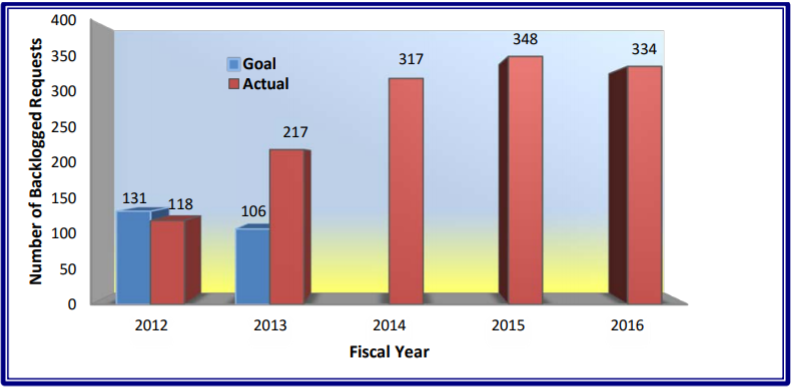
TIGTA also found that at the end of Fiscal Year 2016, there were 334 backlogged information requests. Below is a chart from the report showing the IRS’s recent history of backlogged FOIA requests.

TIGTA’s findings are consistent with our experiences with FOIA requests. It is not unusual for the IRS to make repeated requests for extensions to respond. We note further that, during an examination, the IRS is statutorily authorized to provide taxpayers access to their administrative file. Indeed, the Internal Revenue Manual confirms this at section 4.2.5.7 (June 15, 2017). Yet the IRS examination team often requires a FOIA request.

Practice Point 1: As a result of the IRS’s FOIA backlog, some taxpayers have resorted to filing lawsuits in federal district court to enforce their FOIA rights. Because the IRS must respond to court deadlines, taxpayers are sometimes able to force a more expedient response and move to the front of the response line.

Practice Point 2: Taxpayers should attempt to tailor their FOIA requests, only requesting the information in which they are interested. In theory, this could make the IRS’s job easier and, in turn, responses more timely.

Practice Point 3: If taxpayers intend to seek information from the government through the FOIA process, they should do so as soon as possible (e.g., at the beginning of the examination process) so that they may get the information in time to be useful.


read more

IRS Valuation Expert for Michael Jackson Estate Case Almost Thrown Out!

On September 29, 2017, Judge Mark Holmes of the United States Tax Court (Tax Court) issued an order in the estate tax valuation case brought by the Estate of Michael Jackson (the Estate). In the case, the Estate moved to strike the testimony of the Internal Revenue Service’s (IRS) valuation expert witness on the grounds that he lied. The IRS acknowledged that its expert “did not tell the truth when he testified that he did not work on or write a valuation report for the IRS Examination Division in the third-party taxpayer audit.” Apparently, the expert had worked on the valuation of Whitney Houston’s Estate on behalf of the IRS, and failed to list the engagement in his report. He also omitted one publication that he wrote and one case in which he provided expert-witness testimony at a deposition.

The question for the Court was the proper remedy for the omissions, with sanctions ranging from striking all of the expert’s testimony (and thereby depriving the IRS of the only evidence in its favor on the key issues in the case) to discounting the expert’s testimony and weight to be given to his opinions. The Court decided to take the latter route.

The Court explained that striking expert testimony pursuant to Tax Court Practice and Procedure Rule 143(g) (governing expert witness reports) occurs when a putative expert omits information from the report without good cause for the omission. In this case, the Court explained that the IRS’s expert failed to disclose his valuation work on his long list of expert-testimony engagements attached to his resume, but ruled that the omission was merely a “clerical error.” However, the expert did provide false testimony at trial when he testified he did not work on or write a valuation report in the matter involving Whitney Houston’s Estate. The Court determined that there had to be some negative consequences for the expert’s false testimony, and settled on discounting his credibility and opinions.

Practice Point: The order in Estate of Michael Jackson, as well as the Tax Court’s prior opinion in Tucker v. Commissioner, TC Memo. 2017-183, highlight a very important aspect of preparing an expert report for submission in Tax Court: it must be complete and accurate at the time of its submission. It is good practice to run a litigation database search (e.g., Lexis or Westlaw) on your expert’s testimony experience as a check on what the expert has listed in his report.


read more

Is a Business Tax Reform Game Plan Beginning to Take Shape?

Substantial tax reform is underway and the business community is intently awaiting details of this activity with the aim of positioning themselves to maximize opportunities and minimize any costs or risks that reform may present. How will a cut in the corporate income tax rate, the potential adoption of a “territorial” dividend exemption system or the elimination or altering of recent regulations impact companies?

Continue Reading


read more

IRS Guidance Says IRS Can Disclose Confidential Taxpayer Information to Whistleblower with Impunity

Every taxpayer should be aware of the real risk that its own employees could disclose the taxpayer’s confidential and privileged information to the Internal Revenue Service (IRS) for a whistleblower fee. Pursuant to Internal Revenue Code (Code) Section 7623, the IRS is permitted to pay a “whistleblower” who discloses information about a taxpayer who has violated the tax laws. The amount of the payment ranges from 15 to 30 percent of the recovery. We have previously reported about issues pertaining to whistleblowers.

While the flow of information is usually from the whistleblower to the IRS, there is also a risk that the IRS can disclose the taxpayer’s return information to the whistleblower. Code Section 6103(a) deems tax returns and return information as confidential and prohibits the disclosure absent an express statutory exception. Return information is broadly defined and includes the information received by the IRS, from any source, during the course of audit. There are several exceptions to this general rule. For example, Code Section 6103(n) authorizes that tax returns and return information may be shared with the IRS pursuant to a “tax administration contract.” The relevant regulations explain when the IRS may disclose information to a whistleblower and its representative.

A recent memo from the IRS’s Whistleblower Office provides the reasoning behind the IRS decision to enter into a whistleblower contract in order to share the taxpayer’s feeling empowered to share otherwise confidential protected information with whistleblowers. (more…)


read more

Tax Court Announces 2018 Judicial Conference in Chicago on March 26-28, 2018

On Friday, September 15, the Tax Court announced that it will be holding its 2018 Judicial Conference in Chicago, Illinois, on the campus of Northwestern University’s Pritzker School of Law on March 26-28, 2018. The press release provides:

The 2018 Tax Court Judicial Conference will be held in Chicago, Illinois, on the campus of Northwestern University’s Pritzker School of Law on Monday evening, March 26, 2018, Tuesday, March 27, 2018 (entire day), and Wednesday, March 28, 2018 (half day). The purpose of the judicial conference is to provide attendees with the opportunity to (1) review and discuss issues of material interest regarding the tax litigation process, (2) discuss ways in which the tax litigation process in the Court may be improved, and (3) network with fellow Tax Court practitioners. In addition to the Judges of the United States Tax Court, the Court intends to invite representatives from the Internal Revenue Service, the Department of Justice, private practice, low-income taxpayer clinics, academia, Capitol Hill, and other courts. A variety of plenary and breakout sessions will address issues relevant to practice before the Court.

Applications to attend the 2018 Tax Court Judicial Conference will be accepted from September 15, 2017, through November 15, 2017. An application form is available on the Court’s website at https://www.ustaxcourt.gov/judicial_conference_application.pdf. Please note that space is limited, and the Court may not be able to extend an invitation to all those who apply.

We have attended the Tax Court Judicial Conference on several occasions and have spoken on panels at the conference. The material presented is extremely informative and provides a unique opportunity to personally interact with judges and fellow Tax Court practitioners. Applications are being accepted from now through November 15, 2017, either by email or regular mail. If you plan to attend, please send us an email so we can say hello!


read more

EDITOR IN CHIEF

STAY CONNECTED

TOPICS

ARCHIVES

jd supra readers choice top firm 2023 badge
US Tax Disputes Firm of the Year 2025
2026 Best Law Firms - Law Firm of the Year (Tax Law)