
The outline of pending tax reform provisions remain vague, but a significant impact on M&A activity is expected by way of corporate tax cuts, interest deductibility, changes to the expensing of capital investments, a reduction of the pass-through tax rate and changes to our international (territorial) tax system.
In recent months, the Internal Revenue Service (IRS) Large Business and International Division (LB&I) has issued a variety of international tax practice “units” as part of its process to improve tax compliance from identified groups of business taxpayers. The overall process also includes short descriptions of respective “campaigns” and briefly describes the agency’s designated, tailored treatment or treatments for each campaign.
Most recently, it issued a unit on the mutual agreement procedure (MAP), commonly referred to as the Competent Authority Process under bilateral tax treaties (Doc Control No. ISO/P/01_07_03-01). The purpose of the unit is to provide IRS examiners (for the most part, the unit does not address foreign-initiated adjustments) with clear guidance on their responsibility in situations where proposed adjustments will be made in a context in which the taxpayer could potentially face double taxation, consistent with the most recent revenue procedure (Rev. Proc.) 2015-40. The unit also provides a helpful checklist for taxpayers in such situations.
The unit amplifies the guidance in Rev. Proc. 2015-40 with respect to both issues arising in Advance Pricing and Mutual Agreement (APMA) and Treaty Assistance and Interpretation Team (TAIT) (for non-transfer pricing issues). The discussion is consistent with current practice. Critical issues addressed include the following. (more…)
On September 21, the Internal Revenue Service (IRS) released Revenue Procedure 2017-52 which introduces an 18 month pilot program expanding the scope of the IRS’s ruling practice with respect to distributions under Internal Revenue Code (Code) Section 355. Prior to Revenue Procedure 2017-52, the IRS had determined that it would not issue letter rulings on whether a distribution qualified for tax-free treatment under Code Section 355. See Revenue Procedure 2013-32. Instead, the IRS had limited its rulings under Code Section 355 to merely addressing “significant issues.” Id. Now, with the introduction of Revenue Procedure 2017-52, a taxpayer may obtain a “transactional ruling” that specifically addresses the general federal income tax consequences of a transaction intended to qualify as tax-free under Section 355.
Practice Point: A letter ruling is an excellent way for taxpayers to gain certainty with respect to a Section 355 transaction and to head off potential controversy with the IRS.
On October 2, 2017, the US Department of the Treasury (Treasury) submitted a report (Report) to the President of the United States recommending the withdrawal, revocation or revision of eight Treasury Regulations in order to eliminate or otherwise mitigate the “burdens imposed on taxpayers.” This action springs from Executive Order 13789 issued by the President on April 21, 2017, calling on Treasury to identify and reduce tax regulatory burdens that impose undue financial burdens on US taxpayers or otherwise add undue complexity to federal tax laws.
The Report is largely consistent with Treasury’s interim report dated June 22, 2017, but sets forth in greater detail the specific actions recommended by Treasury. However, the Report also stated that Treasury is considering possible reforms of several recent regulations not identified in its interim report, such as regulations under Internal Revenue Code (Code) Section 871(m) (relating to payments treated as US source dividends) and the Foreign Account Tax Compliance Act. The Report also states that Treasury and the Internal Revenue Service (IRS) have initiated a comprehensive review of all regulations—regardless of when they were issued—that is coordinated by the Treasury Regulatory Reform Task Force and is a furtherance of executive orders adopting a PAYGO approach to regulations. (more…)
“[W]e are not inclined to carve out an approach to administrative review good for tax law only.” Mayo Found. for Medical Educ. & Research v. United States, 562 US 44, 55 (2011).
With this language, the US Supreme Court put taxpayers and the Internal Revenue Service (IRS) and US Department of the Treasury (Treasury) on notice that administrative law applies equally to tax law. Since this announcement, administrative law issues have figured prominently in several tax cases with the result that certain practices of the IRS and Treasury in issuing regulations have been called into question. (Please see our most recent post on the Administrative Procedures Act [APA] as applied to notices of deficiency issued by the IRS.) One such practice is the issuance of temporary regulations—without prior opportunity for comment by the public—that the IRS and Treasury treat as binding rules of law. One such example is the temporary anti-inversion regulations issued in April 2016 that address transactions that the IRS and Treasury believe are structured to avoid the purposes of Internal Revenue Code (Code) Section 7874 and 367.
As is common practice by the IRS and Treasury, the regulations were simultaneously issued in both proposed and temporary form. The regulations include the rules described in prior Notices, as well as new rules designed to address issues not covered by the Notices. The regulations totaled more than 200 pages, addressing many issues in the area. (more…)
On September 7, 2017, the Treasury Inspector General for Tax Administration (TIGTA) issued a report about the Internal Revenue Service’s (IRS) Freedom of Information Act (FOIA) procedures. After reviewing a statistically valid sample of FOIA requests, TIGTA concluded that the IRS improperly withheld information 14.3 percent of the time—or approximately 1 in 7 FOIA requests.
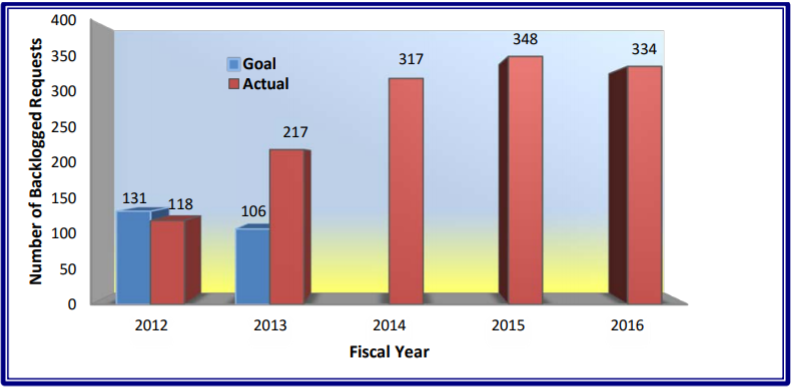
TIGTA also found that at the end of Fiscal Year 2016, there were 334 backlogged information requests. Below is a chart from the report showing the IRS’s recent history of backlogged FOIA requests.
TIGTA’s findings are consistent with our experiences with FOIA requests. It is not unusual for the IRS to make repeated requests for extensions to respond. We note further that, during an examination, the IRS is statutorily authorized to provide taxpayers access to their administrative file. Indeed, the Internal Revenue Manual confirms this at section 4.2.5.7 (June 15, 2017). Yet the IRS examination team often requires a FOIA request.
Practice Point 1: As a result of the IRS’s FOIA backlog, some taxpayers have resorted to filing lawsuits in federal district court to enforce their FOIA rights. Because the IRS must respond to court deadlines, taxpayers are sometimes able to force a more expedient response and move to the front of the response line.
Practice Point 2: Taxpayers should attempt to tailor their FOIA requests, only requesting the information in which they are interested. In theory, this could make the IRS’s job easier and, in turn, responses more timely.
Practice Point 3: If taxpayers intend to seek information from the government through the FOIA process, they should do so as soon as possible (e.g., at the beginning of the examination process) so that they may get the information in time to be useful.
We have previously written about QinetiQ U.S. Holdings. Inc.’s (QinetiQ) fight to apply the Administrative Procedure Act (APA) to notices of deficiency issued by the Internal Revenue Service (IRS). (See below for our recent coverage.)
In short, the Tax Court and the US Court of Appeals for the Fourth Circuit rejected QinetiQ’s argument that a one-sentence reason for a deficiency determination contained in a notice of deficiency violated the APA because it was arbitrary, capricious, an abuse of discretion, or otherwise not in accordance with law.” Undeterred, QinetiQ filed a petition for certiorari seeking review from the Supreme Court. Alas, the saga ends for QinetiQ as the Supreme Court denied the petition this morning.
Practice Point: Although QinetiQ was not successful in its APA arguments, other APA arguments in the tax law have gained considerable traction in recent years. We will be posting soon on the recent order out of the Western District of Texas invaliding Treas. Reg. § 1.7874-8T on the grounds that this temporary regulations was unlawfully issued without adherence to the APA’s notice-and-comment requirements. Additionally, as we previously noted, other procedural arguments exists when a notice of deficiency contains a minimal explanation, such as potentially shifting the burden of proof to the IRS.
On September 29, 2017, Judge Mark Holmes of the United States Tax Court (Tax Court) issued an order in the estate tax valuation case brought by the Estate of Michael Jackson (the Estate). In the case, the Estate moved to strike the testimony of the Internal Revenue Service’s (IRS) valuation expert witness on the grounds that he lied. The IRS acknowledged that its expert “did not tell the truth when he testified that he did not work on or write a valuation report for the IRS Examination Division in the third-party taxpayer audit.” Apparently, the expert had worked on the valuation of Whitney Houston’s Estate on behalf of the IRS, and failed to list the engagement in his report. He also omitted one publication that he wrote and one case in which he provided expert-witness testimony at a deposition.
The question for the Court was the proper remedy for the omissions, with sanctions ranging from striking all of the expert’s testimony (and thereby depriving the IRS of the only evidence in its favor on the key issues in the case) to discounting the expert’s testimony and weight to be given to his opinions. The Court decided to take the latter route.
The Court explained that striking expert testimony pursuant to Tax Court Practice and Procedure Rule 143(g) (governing expert witness reports) occurs when a putative expert omits information from the report without good cause for the omission. In this case, the Court explained that the IRS’s expert failed to disclose his valuation work on his long list of expert-testimony engagements attached to his resume, but ruled that the omission was merely a “clerical error.” However, the expert did provide false testimony at trial when he testified he did not work on or write a valuation report in the matter involving Whitney Houston’s Estate. The Court determined that there had to be some negative consequences for the expert’s false testimony, and settled on discounting his credibility and opinions.
Practice Point: The order in Estate of Michael Jackson, as well as the Tax Court’s prior opinion in Tucker v. Commissioner, TC Memo. 2017-183, highlight a very important aspect of preparing an expert report for submission in Tax Court: it must be complete and accurate at the time of its submission. It is good practice to run a litigation database search (e.g., Lexis or Westlaw) on your expert’s testimony experience as a check on what the expert has listed in his report.
The White House and Republican congressional leadership released an outline this week to guide forthcoming legislation on tax reform. This outline will serve as a useful framework in structuring what will be an active, and likely contentious, phase of reform activity.